
SPLK-3003 · Question #82
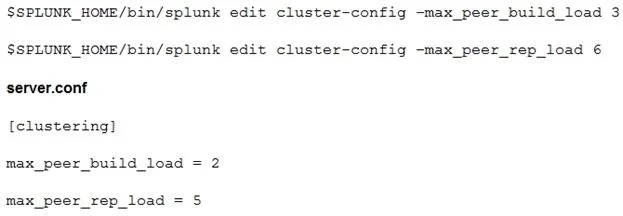
What should be considered when running the following CLI commands with a goal of accelerating an index cluster migration to new hardware?
The correct answer is B. Network latency and storage IOPS. When migrating an index cluster (e.g., Elasticsearch) to new hardware, network latency directly limits the speed at which index shards and data can be transferred between nodes, while storage IOPS determines how quickly the source can read and the destination can write data…
Question
What should be considered when running the following CLI commands with a goal of accelerating an index cluster migration to new hardware?
Exhibit
Options
- AData ingestion rate
- BNetwork latency and storage IOPS
- CDistance and location
- DSSL data encryption
How the community answered
(30 responses)- A7% (2)
- B77% (23)
- C13% (4)
- D3% (1)
Explanation
When migrating an index cluster (e.g., Elasticsearch) to new hardware, network latency directly limits the speed at which index shards and data can be transferred between nodes, while storage IOPS determines how quickly the source can read and the destination can write data - both are the true hardware bottlenecks that CLI migration commands (like shard rerouting or snapshot/restore) must contend with.
Why the distractors are wrong:
- A (Data ingestion rate): Ingestion rate matters for live cluster capacity planning, but during migration you're moving existing data - not optimizing for new writes.
- C (Distance and location): Physical distance is already subsumed by network latency; it's not a discrete CLI tuning parameter and is too vague to act on.
- D (SSL encryption): Encryption is a security concern, not a migration speed lever - disabling it to gain speed would be a poor trade-off and isn't a recommended optimization target.
Memory tip: Think of it as "pipe speed + disk speed" - latency governs how responsive the network pipe is, and IOPS governs how fast storage can keep up. If either bottlenecks, your migration CLI commands will wait regardless of any other setting.
Topics
Community Discussion
No community discussion yet for this question.