
SPLK-1002 · Question #172
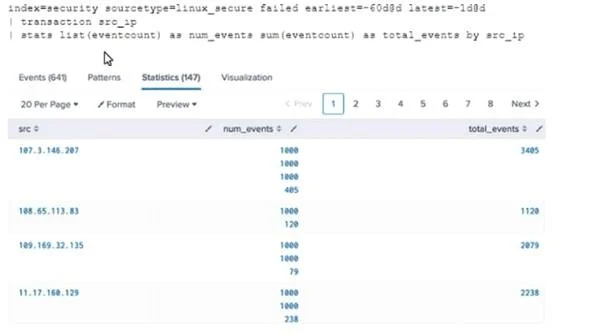
Why would the following search produce multiple transactions instead of one?
The correct answer is A. The maxspan option is not included. In Splunk, the transaction command is used to group events that share common characteristics into a single transaction. By default, the transaction command groups all matching events into a single transaction. However, you can use the maxspan option to limit the time span of…
Question
Why would the following search produce multiple transactions instead of one?
Exhibit
Options
- AThe maxspan option is not included.
- BThe transaction command has a limit of 1000 events per transaction.
- CThe transaction and commands cannot be used together.
- DThe stats list () function is used.
How the community answered
(56 responses)- A88% (49)
- B2% (1)
- C4% (2)
- D7% (4)
Explanation
In Splunk, the transaction command is used to group events that share common characteristics into a single transaction. By default, the transaction command groups all matching events into a single transaction. However, you can use the maxspan option to limit the time span of the transactions. If the time span between the first and last event in a transaction exceeds the maxspan value, the transaction command will start a new transaction. Therefore, if the maxspan option is not included in the search, the transaction command might produce multiple transactions instead of one if the time span between the first and last event in a transaction exceeds the default maxspan value. Here is an example of how you can use the maxspan option in a search: index=main sourcetype=access_combined | transaction someuniqefield maxspan=1h In this search, the transaction command groups events that share the same someuniqefield value into a single transaction, but only if the time span between the first and last event in the transaction does not exceed 1 hour. If the time span exceeds 1 hour, the transaction command will start a new transaction.
Topics
Community Discussion
No community discussion yet for this question.