
SOA-C02 · Question #597
A company wants to enhance its security by applying IAM permissions boundaries. The company tries to use IAM policy conditions and receives the following error: "Error: error updating IAM Role…
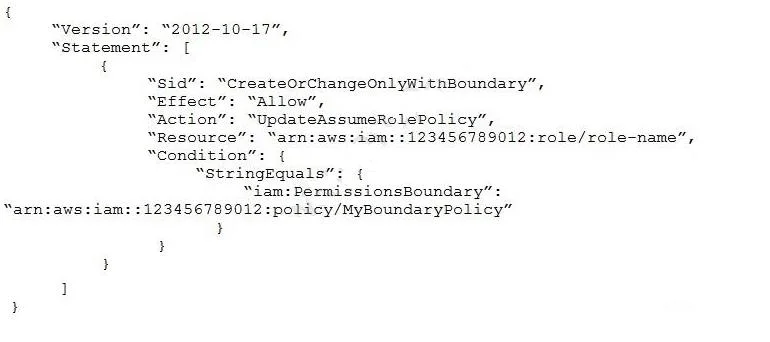
The correct answer is A. The UpdateAssumeRolePolicy action is not compatible with the iam:PermissionsBoundary. Option A is correct because iam:PermissionsBoundary is a condition key that AWS only supports for specific IAM actions - specifically those that create or attach permissions boundaries (like iam:CreateRole, iam:PutRolePermissionsBoundary). The iam:UpdateAssumeRolePolicy action…
Question
A company wants to enhance its security by applying IAM permissions boundaries. The company tries to use IAM policy conditions and receives the following error:
"Error: error updating IAM Role (role-name) assume role policy:
AccessDenied: User: id-arn is not authorized to perform:
iam:UpdateAssumeRolePolicy on resource: role role-namestatus code:
403, request id: request-id" The policy that contains the condition includes the following snippet:
What is the reason for the error?
Exhibit
Options
- AThe UpdateAssumeRolePolicy action is not compatible with the iam:PermissionsBoundary
- BCondition keys are not allowed in conjunction with permissions boundaries.
- CPermissions boundaries are not allowed with IAM policies.
- DIAM user id-arn is not allowed to assume role-name.
How the community answered
(41 responses)- A73% (30)
- B2% (1)
- C17% (7)
- D7% (3)
Explanation
Option A is correct because iam:PermissionsBoundary is a condition key that AWS only supports for specific IAM actions - specifically those that create or attach permissions boundaries (like iam:CreateRole, iam:PutRolePermissionsBoundary). The iam:UpdateAssumeRolePolicy action does not support this condition key, so when the condition is evaluated, it fails to match, resulting in an implicit deny and the 403 AccessDenied error. Option B is wrong because condition keys are broadly allowed with permissions boundaries - the issue is compatibility with a specific action, not conditions as a category. Option C is incorrect because permissions boundaries are absolutely a feature of IAM policies and work extensively with them. Option D is a misreading of the error - the error is about updating the assume role policy, not about assuming the role itself (which uses sts:AssumeRole).
Memory tip: Think of condition keys like power adapters - iam:PermissionsBoundary only fits into actions that set or attach boundaries; plug it into UpdateAssumeRolePolicy and it simply won't connect, killing the request silently with a deny.
Topics
Community Discussion
No community discussion yet for this question.