
SOA-C02 · Question #39
A company is using an Amazon Aurora MySQL DB cluster that has point-in-time recovery, backtracking, and automatic backup enabled. A SysOps administrator needs to be able to roll back the DB cluster…
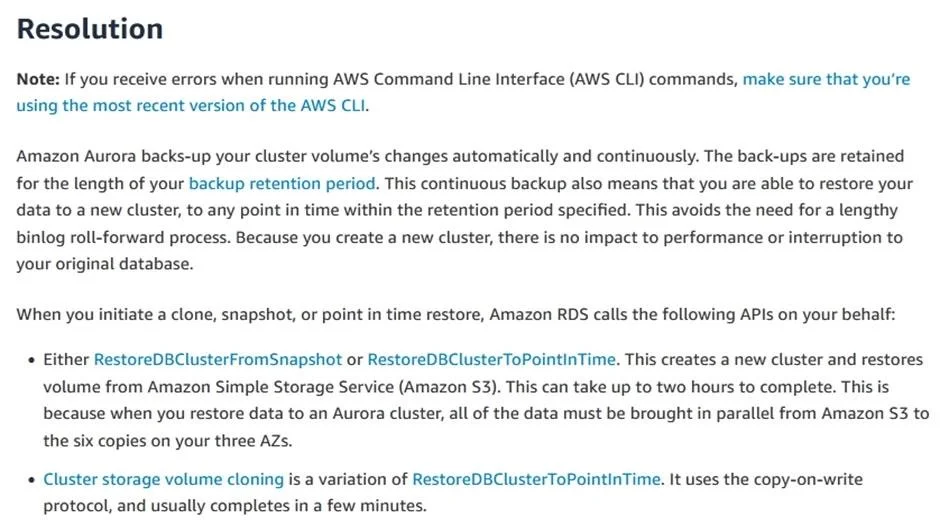
The correct answer is C. Use backtracking to rewind the existing DB cluster to the desired recovery point. https://aws.amazon.com/premiumsupport/knowledge-center/aurora-mysql-slow-snapshot-restore/ https://docs.aws.amazon.com/AmazonRDS/latest/AuroraUserGuide/AuroraMySQL.Managing.Ba
Question
A company is using an Amazon Aurora MySQL DB cluster that has point-in-time recovery, backtracking, and automatic backup enabled. A SysOps administrator needs to be able to roll back the DB cluster to a specific recovery point within the previous 72 hours. Restores must be completed in the same production DB cluster. Which solution will meet these requirements?
Exhibit
Options
- ACreate an Aurora Replica. Promote the replica to replace the primary DB instance.
- BCreate an AWS Lambda function to restore an automatic backup to the existing DB cluster.
- CUse backtracking to rewind the existing DB cluster to the desired recovery point.
- DUse point-in-time recovery to restore the existing DB cluster to the desired recovery point.
How the community answered
(26 responses)- A15% (4)
- B8% (2)
- C73% (19)
- D4% (1)
Explanation
https://aws.amazon.com/premiumsupport/knowledge-center/aurora-mysql-slow-snapshot-restore/ https://docs.aws.amazon.com/AmazonRDS/latest/AuroraUserGuide/AuroraMySQL.Managing.Ba
Topics
Community Discussion
No community discussion yet for this question.