
SCS-C02 · Question #140
A company deploys a set of standard IAM roles in AWS accounts. The IAM roles are based on job functions within the company. To balance operational efficiency and security, a security engineer…
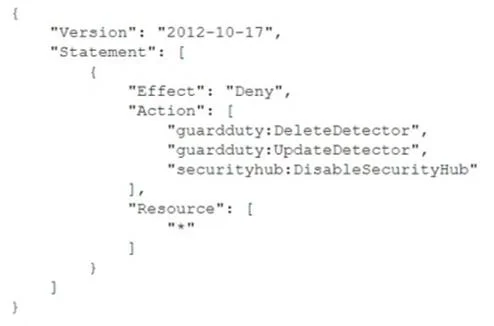
The correct answer is A. { "Version": "2012-10-17", "Statement": [ { "Effect": "Deny", "Action": [ "guardduty:DeleteDetector", "guardduty:UpdateDetector", "securityhub:DisableSecurityHub" ], "Resource": "*" } ] }. Option A is correct because it uses a targeted Deny SCP that explicitly blocks only the specific actions needed to disable GuardDuty and Security Hub (DeleteDetector, UpdateDetector, DisableSecurityHub). In AWS Organizations, SCPs work as guardrails - a Deny in an SCP always…
Question
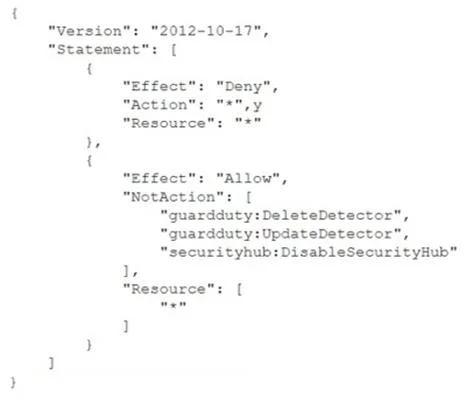
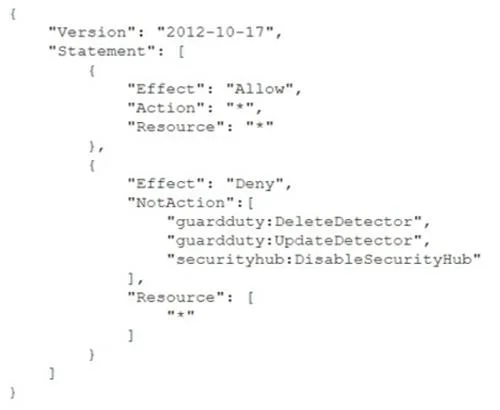
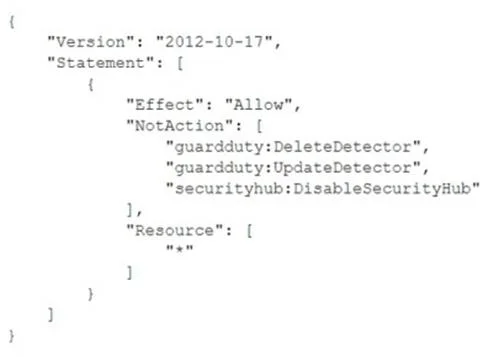
A company deploys a set of standard IAM roles in AWS accounts. The IAM roles are based on job functions within the company. To balance operational efficiency and security, a security engineer implemented AWS Organizations SCPs to restrict access to critical security services in all company accounts. All of the company's accounts and OUs within AWS Organizations have a default FullAWSAccess SCP that is attached. The security engineer needs to ensure that no one can disable Amazon GuardDuty and AWS Security Hub. The security engineer also must not override other permissions that are granted by IAM policies that are defined in the accounts. Which SCP should the security engineer attach to the root of the organization to meet these requirements? A. B. C. D.
Exhibits
Options
- A{ "Version": "2012-10-17", "Statement": [ { "Effect": "Deny", "Action": [ "guardduty:DeleteDetector", "guardduty:UpdateDetector", "securityhub:DisableSecurityHub" ], "Resource": "*" } ] }
- B{ "Version": "2012-10-17", "Statement": [ { "Effect": "Deny", "Action": [ ":,y" ], "Resource": "" }, { "Effect": "Allow", "NotAction": [ "guardduty:DeleteDetector", "guardduty:UpdateDetector", "securityhub:DisableSecurityHub" ], "Resource": "" } ] }
- C{ "Version": "2012-10-17", "Statement": [ { "Effect": "Allow", "Action": ":", "Resource": "" }, { "Effect": "Deny", "NotAction": [ "guardduty:DeleteDetector", "guardduty:UpdateDetector", "securityhub:DisableSecurityHub" ], "Resource": "" } ] }
- D{ "Version": "2012-10-17", "Statement": [ { "Effect": "Allow", "NotAction": [ "guardduty:DeleteDetector", "guardduty:UpdateDetector", "securityhub:DisableSecurityHub" ], "Resource": "*" } ] }
How the community answered
(43 responses)- A65% (28)
- B19% (8)
- C12% (5)
- D5% (2)
Explanation
Option A is correct because it uses a targeted Deny SCP that explicitly blocks only the specific actions needed to disable GuardDuty and Security Hub (DeleteDetector, UpdateDetector, DisableSecurityHub). In AWS Organizations, SCPs work as guardrails - a Deny in an SCP always overrides any Allow in IAM policies, and because this SCP only denies specific actions without touching others, it does not override or restrict any other permissions granted by IAM policies in member accounts. The existing FullAWSAccess SCP already provides broad Allow coverage, so no additional Allow statements are needed in this SCP.
Topics
Community Discussion
No community discussion yet for this question.