
SC-401 · Question #93
Drag and Drop Question You have a Microsoft 365 E5 subscription. You need to label Microsoft Exchange Online emails that match the following conditions: - Contain employment offers - Contain…
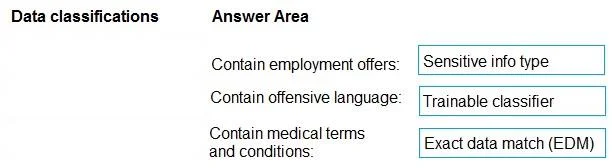
The correct answer is Sensitive info type; Trainable classifier; Exact data match (EDM). The question assesses the ability to correctly apply Microsoft 365 data classification methods (Sensitive Info Types, Exact Data Match, Trainable Classifiers) to different content conditions while minimizing administrative effort.
Question
Exhibits
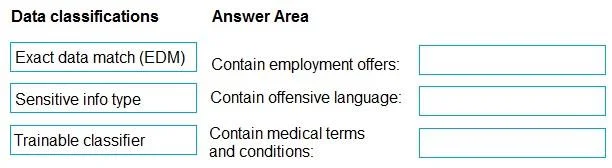
Answer Area
Drag items
Correct arrangement
- Sensitive info type
- Trainable classifier
- Exact data match (EDM)
Explanation
The question assesses the ability to correctly apply Microsoft 365 data classification methods (Sensitive Info Types, Exact Data Match, Trainable Classifiers) to different content conditions while minimizing administrative effort.
Approach. To correctly answer this question, each condition must be matched with the most appropriate data classification type that minimizes administrative effort:
- 'Contain employment offers': Sensitive info type. Employment offers typically contain specific keywords, phrases, and patterns (e.g., 'salary', 'position', 'start date'). Sensitive Information Types (SITs) are predefined or custom-defined patterns, regular expressions, or keyword lists that are effective at detecting such content. This method allows for flexible pattern matching without requiring exact data from a structured source or extensive machine learning training.
- 'Contain offensive language': Trainable classifier. Offensive language is subjective, highly contextual, and constantly evolving. It is impractical and administratively burdensome to maintain a comprehensive list of every offensive word or phrase using exact matches or fixed patterns. Trainable classifiers leverage machine learning to learn from examples (both offensive and non-offensive content). This allows the system to identify offensive language based on learned contextual patterns, significantly reducing administrative effort compared to manual rule creation.
- 'Contain medical terms and conditions': Exact data match (EDM). Medical terms and conditions often refer to specific, structured data, such as a list of diagnoses, drug names, patient IDs, or contractual clauses. Exact Data Match (EDM) is designed to precisely identify sensitive information from a known, structured data source (e.g., a database or CSV file of official medical terms, patient records, or specific policy conditions). This provides highly accurate detection for specific, enumerable data sets, making it ideal for structured medical information.
Common mistakes.
- common_mistake. Common mistakes include misapplying the capabilities of each classification type:
- Using EDM for 'offensive language' or 'employment offers': EDM requires a structured, predefined dataset for exact matching. Offensive language is too subjective and varied, and general employment offers are too broad for EDM to be efficient or accurate. Trying to define every possible offensive word or employment-related phrase in a structured database would be an immense and ineffective administrative task.
- Using Sensitive Info Types for 'offensive language': While custom SITs can use keywords, maintaining a comprehensive and up-to-date list of all offensive language (which is context-dependent and evolves) would be an overwhelming administrative burden. SITs are better for more stable patterns.
- Using Trainable Classifiers for 'medical terms and conditions': While a trainable classifier could be trained, EDM is far more precise and efficient when dealing with a finite, structured list of terms that require exact identification. Using a trainable classifier for structured, exact data would be less accurate and an unnecessary use of machine learning when a simpler, more direct method like EDM is available.
- Interchanging SITs and EDM for 'employment offers' and 'medical terms': SITs are good for patterns and keywords (like typical phrases in 'employment offers'), whereas EDM is specifically designed for high-precision exact matches against large, structured datasets (like specific 'medical terms' from a database). Mixing these would either lead to low precision or high administrative overhead.
Concept tested. Microsoft 365 Information Protection, Data Loss Prevention (DLP) capabilities, and data classification methods, specifically the appropriate application of Sensitive Information Types (SITs), Exact Data Match (EDM), and Trainable Classifiers based on the nature of the data and the goal of minimizing administrative effort.
Topics
Community Discussion
No community discussion yet for this question.