
SC-300 · Question #254
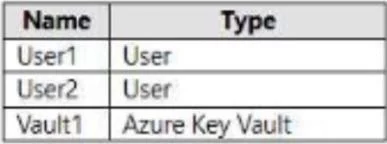
Hotspot Question You have an Azure subscription that contains the resources shown in the following table. You need to configure access to Vault1. The solution must meet the following requirements…
The correct answer is User1: Key Vault Crypto Officer; User2: Key Vault Certificate User. This question tests knowledge of Azure Key Vault built-in RBAC roles and the principle of least privilege when assigning permissions to users for different Key Vault operations.
Question
Exhibit
Answer Area
- User1Key Vault Crypto OfficerKey Vault Crypto OfficerKey Vault Certificate UserKey Vault Secrets UserContributorReaderOwner
- User2Key Vault Certificate UserKey Vault Crypto OfficerKey Vault Certificate UserKey Vault Secrets UserContributorReaderOwner
Explanation
This question tests knowledge of Azure Key Vault built-in RBAC roles and the principle of least privilege when assigning permissions to users for different Key Vault operations.
Approach. For User1, who needs to manage and create keys in Vault1, the correct role is 'Key Vault Crypto Officer'. This role grants full control over cryptographic keys including creating, deleting, updating, and managing keys, but does not grant access to secrets or certificates - following least privilege. For User2, who only needs to access (read) a certificate stored in Vault1, the correct role is 'Key Vault Certificate User' (or 'Key Vault Certificates Officer' if they need read-only access). 'Key Vault Certificate User' allows reading/using certificate contents, which satisfies the requirement of accessing a stored certificate without granting unnecessary permissions over keys or secrets. These built-in RBAC roles, introduced with the Azure RBAC authorization model for Key Vault, provide granular, least-privilege access compared to the older access policy model.
Concept tested. Azure Key Vault RBAC roles - specifically the granular built-in roles such as Key Vault Crypto Officer (for key management) and Key Vault Certificate User (for certificate access), and applying the principle of least privilege by selecting the most restrictive role that satisfies each user's requirements.
Reference. https://docs.microsoft.com/en-us/azure/key-vault/general/rbac-guide
Topics
Community Discussion
No community discussion yet for this question.