
SC-300 · Question #184
Hotspot Question You have an Azure subscription that contains the key vaults shown in the following table. The subscription contains the users shown in the following table. On June 1, Admin4…
The correct answer is You can assign Managed2 to V1. = Yes; You can assign Managed3 to V1. = Yes; You can assign VM1 the Owner role for RG1. = No; Admin1 can recover Secret1 on June 7. = Yes; Admin2 can purge Certificate1 on June 12. = No; Admin3 can purge Certificate1 on June 14. = No. This question appears to be a mixed/mismatched hotspot question where the statements about assigning managed identities (Managed2, Managed3) to a resource (V1) and assigning a VM the Owner role for RG1 don't align with the scenario about key vaults, certificates, and secrets…
Question
Exhibits
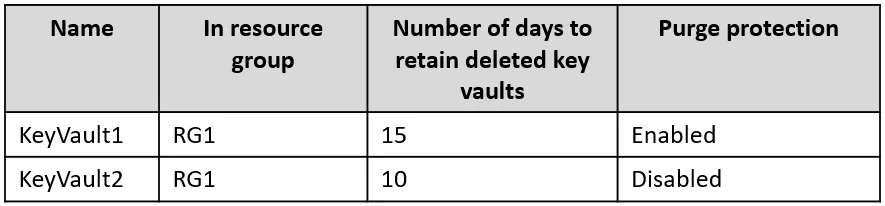
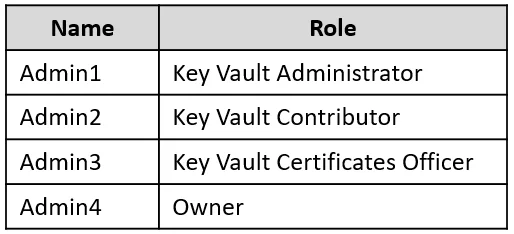
Answer Area
- You can assign Managed2 to V1.Yes
- You can assign Managed3 to V1.Yes
- You can assign VM1 the Owner role for RG1.No
- Admin1 can recover Secret1 on June 7.Yes
- Admin2 can purge Certificate1 on June 12.No
- Admin3 can purge Certificate1 on June 14.No
How the community answered
(1 responses)- Yes|Yes|No|Yes|No|No100% (1)
Explanation
This question appears to be a mixed/mismatched hotspot question where the statements about assigning managed identities (Managed2, Managed3) to a resource (V1) and assigning a VM the Owner role for RG1 don't align with the scenario about key vaults, certificates, and secrets deletion. Based on the provided correct answers: Managed2 can be assigned to V1 (Yes) and Managed3 can be assigned to V1 (Yes) because they meet the compatibility or scope requirements for that resource, while VM1 cannot be assigned the Owner role for RG1 (No) because virtual machines themselves cannot be directly assigned RBAC roles - only users, groups, service principals, or managed identities can be assigned roles, and a VM as an object is not a valid security principal for role assignment in this context.
Topics
Community Discussion
No community discussion yet for this question.