
SC-100 · Question #128
Drag and Drop Question For a Microsoft cloud environment, you need to recommend a security architecture that follows the Zero Trust principles of the Microsoft Cybersecurity Reference Architectures…
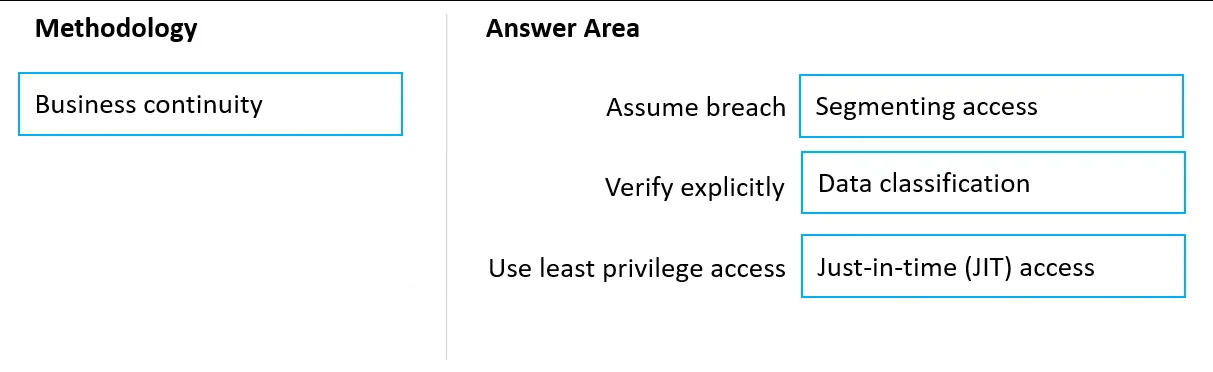
The correct answer is Assume breach: Segmenting access; Verify explicitly: Data classification; Use least privilege access: Just-in-time (JIT) access. This question requires matching specific security methodologies to their corresponding Zero Trust principles, as demonstrated by the provided solution image, to build a resilient cloud security architecture.
Question
Exhibits
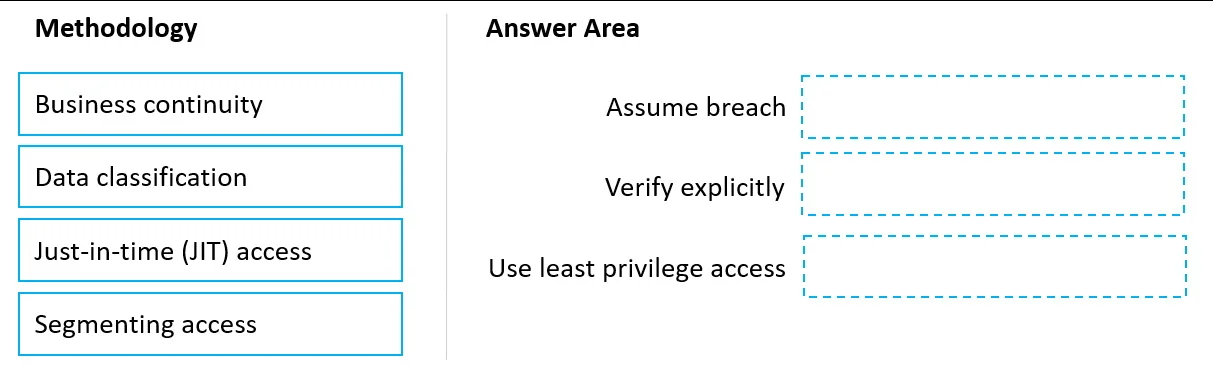
Answer Area
Drag items
Correct arrangement
- Assume breach: Segmenting access
- Verify explicitly: Data classification
- Use least privilege access: Just-in-time (JIT) access
Explanation
This question requires matching specific security methodologies to their corresponding Zero Trust principles, as demonstrated by the provided solution image, to build a resilient cloud security architecture.
Approach. The correct interaction is to drag the specified methodologies to their corresponding Zero Trust principles as shown in the solution image:
-
Drag 'Segmenting access' to 'Assume breach'.
- Reasoning: The 'Assume breach' principle dictates that organizations should operate as if a breach has already occurred or is imminent. 'Segmenting access' (e.g., network segmentation, micro-segmentation) is a core methodology for this principle because it limits the blast radius of a potential breach, preventing an attacker from moving laterally across the entire environment. If one segment is compromised, others remain protected, embodying the 'assume breach' mindset.
-
Drag 'Data classification' to 'Verify explicitly'.
- Reasoning: The 'Verify explicitly' principle requires all access requests to be authenticated and authorized based on all available data points. 'Data classification' provides crucial context about the sensitivity and importance of the resources being accessed. For instance, accessing highly confidential data would trigger stricter verification requirements (e.g., multi-factor authentication, device compliance checks) compared to accessing public data. Without knowing the classification of the data, explicit verification cannot be properly tailored or enforced.
-
Drag 'Just-in-time (JIT) access' to 'Use least privilege access'.
- Reasoning: The 'Use least privilege access' principle states that users should only be granted the minimum necessary permissions to perform their tasks, and only for the required duration. 'Just-in-time (JIT) access' is a direct implementation of this principle. It grants elevated privileges only when they are needed and for a limited time, automatically revoking them afterward. This prevents persistent privileged access, significantly reducing the attack surface.
Common mistakes.
-
common_mistake. A common mistake would be to misinterpret the relationship between the methodologies and principles, or to inappropriately use 'Business continuity'.
-
Business continuity: This methodology is left unused because while it is a critical aspect of overall organizational resilience and security, it is not a direct implementable methodology for the specific Zero Trust access principles listed ('Assume breach', 'Verify explicitly', 'Use least privilege access'). Business continuity focuses on maintaining operations during disruptions, rather than defining access control, verification, or privilege management in the Zero Trust model.
-
Incorrect pairing (e.g., 'Data classification' with 'Assume breach'): While data classification is important for an overall security posture, it doesn't directly implement the 'assume breach' principle which focuses on containment and limiting lateral movement. 'Segmenting access' directly addresses limiting the blast radius.
-
Incorrect pairing (e.g., 'Just-in-time access' with 'Verify explicitly'): JIT access is about how much privilege and for how long (least privilege), not about the factors used to make an access decision (explicit verification). Explicit verification is informed by factors like user identity, device health, location, and data sensitivity (classification).
Concept tested. The core concept tested is the understanding of Microsoft's Zero Trust security principles (Assume breach, Verify explicitly, Use least privilege access) and their corresponding practical implementation methodologies in a cloud environment, as derived from the Microsoft Cybersecurity Reference Architectures (MCRA).
Topics
Community Discussion
No community discussion yet for this question.