
PT0-003 · Question #243
SIMULATION A penetration tester is using a test account within an application to discover any vulnerabilities within the change email function. During testing, the penetration tester discovers the…
The correct answer identifies Cross-Site Request Forgery (CSRF) as the attack type because the application's change email function accepts POST requests authenticated solely by a session cookie, with no anti-CSRF token or other origin-verification mechanism present. This allows…
Question
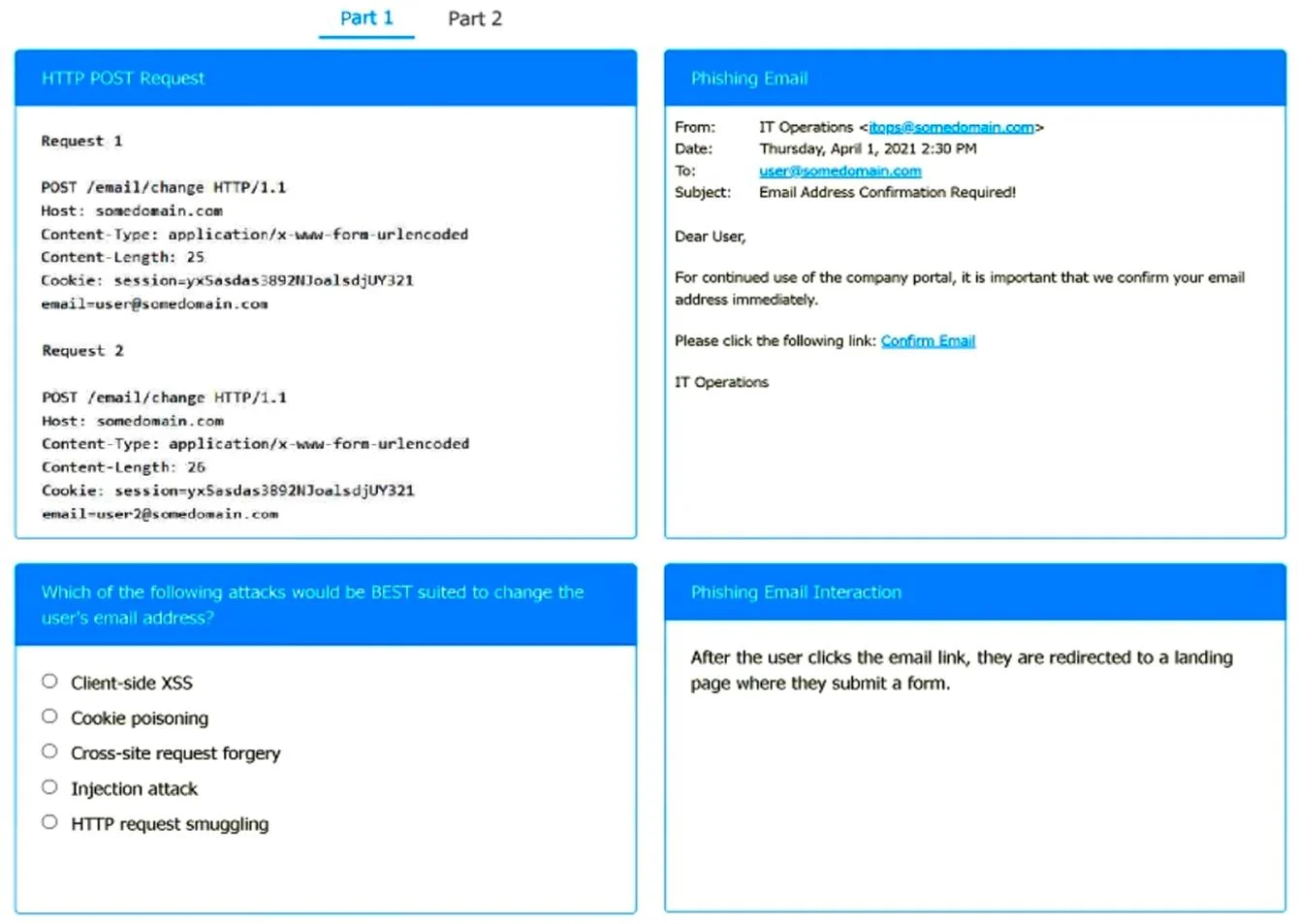
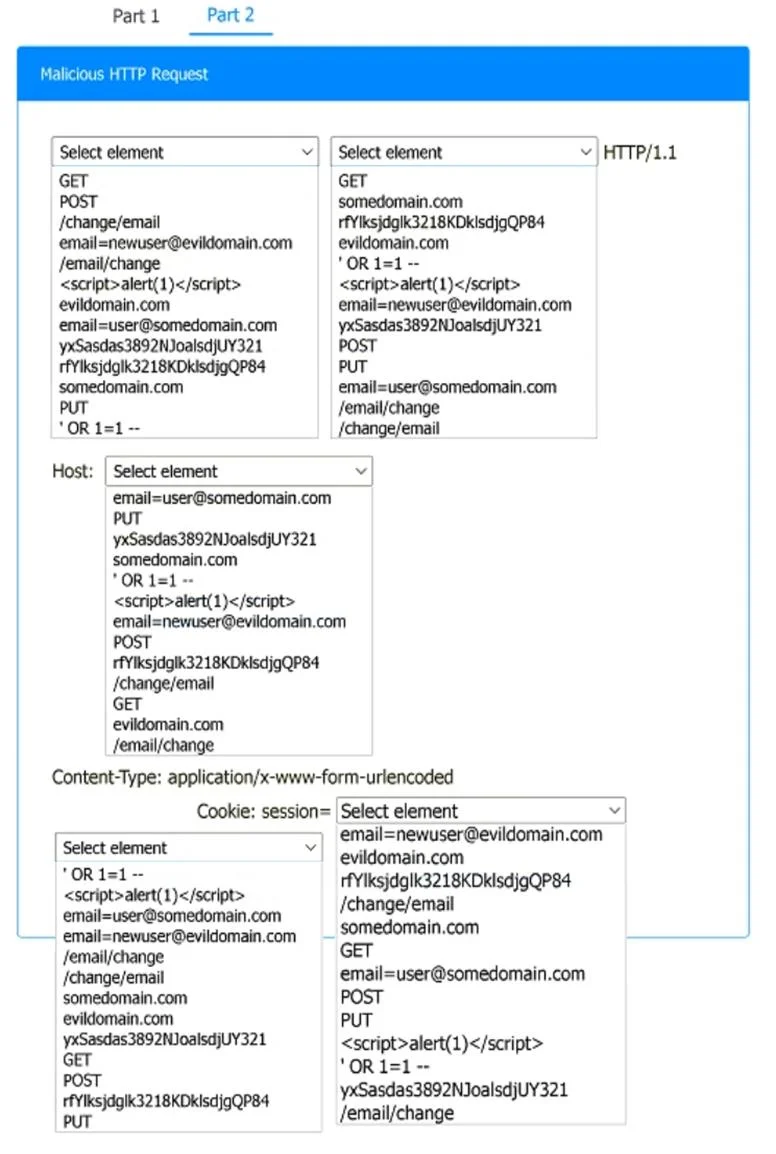
SIMULATION A penetration tester is using a test account within an application to discover any vulnerabilities within the change email function. During testing, the penetration tester discovers the application is vulnerable to an attack that would allow for the tester to change a user’s email address wile logged in. The user's account would be disabled after three unsuccessful login attempts. INSTRUCTIONS Part 1 Examine the two HTTP requests in which the penetration tester was successful in changing the test email address within the application and identify the type of attack that has most likely exploited the vulnerability. Part 2 Use the drop-down menus to select elements to represent the malicious HTTP request that will accomplish the desired exploit. If at any time you would like to bring back the initial state of the simulation, please click the Reset All button. Answer:
Part 1 - Identifying the Attack Type The penetration tester is able to change the user's email address by exploiting a vulnerability. Given the provided HTTP request, the best-suited attack to achieve this is Cross-Site Request Forgery (CSRF). CSRF exploits the trust a website has in the user's browser by forcing an authenticated user to submit a request unknowingly. In this case, the attacker could craft a malicious request to change the user's email address without their consent. This is possible if the application does not properly validate the request source (e.g., using CSRF tokens). Part 2 - Correct Malicious HTTP Request Selections (Based on Images) To craft the correct malicious HTTP request based on the available elements in the dropdown menus:
- First Dropdown (HTTP Method): POST
- Second Dropdown (Endpoint Path): /email/change
- Host: somedomain.com
- Cookie (Session): yxSasdas3892NJoalsdjUY321
- Payload (Email Parameter Change): email=[email protected]
This selection ensures that the malicious request successfully changes the email address of the logged-in user by exploiting Cross-Site Request Forgery (CSRF) or possibly Cookie Poisoning if the session value can be manipulated.
Exhibits
Explanation
The correct answer identifies Cross-Site Request Forgery (CSRF) as the attack type because the application's change email function accepts POST requests authenticated solely by a session cookie, with no anti-CSRF token or other origin-verification mechanism present. This allows an attacker to craft a malicious HTTP request that, when triggered by a victim's browser while they are authenticated, will silently change their email address without their knowledge. The malicious request succeeds because the browser automatically appends the victim's session cookie to any cross-origin request targeting the vulnerable endpoint.
Topics
Community Discussion
No community discussion yet for this question.