
PT0-001 · Question #12
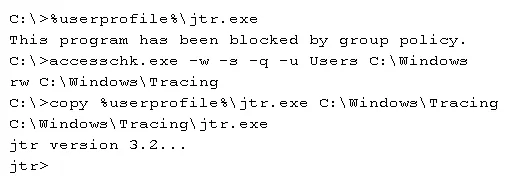
A penetration tester executes the following commands: Which of the following is a local host vulnerability that the attacker is exploiting?
The correct answer is A. Insecure file permissions. Insecure file permissions allow a local attacker to read, modify, or execute files beyond their privilege level, enabling privilege escalation or unauthorized access on the local host.
Question
A penetration tester executes the following commands:
Which of the following is a local host vulnerability that the attacker is exploiting?
Exhibit
Options
- AInsecure file permissions
- BApplication whitelisting
- CShell escape
- DWritable service
How the community answered
(20 responses)- A70% (14)
- B5% (1)
- C15% (3)
- D10% (2)
Why each option
Insecure file permissions allow a local attacker to read, modify, or execute files beyond their privilege level, enabling privilege escalation or unauthorized access on the local host.
When critical files such as scripts, service binaries, or configuration files have overly permissive access controls (e.g., world-writable permissions), a low-privileged attacker can modify them to execute arbitrary code under a higher-privileged context such as root or SYSTEM, making insecure file permissions a classic local privilege escalation vector.
Application whitelisting is a defensive security control that restricts which programs can execute - it is not a vulnerability being exploited in a local privilege escalation scenario.
Shell escape involves breaking out of a restricted shell environment (such as rbash) to gain a full shell, which is a different technique not centered on file permission weaknesses.
A writable service refers specifically to a service whose binary path can be replaced due to incorrect ACLs on the executable itself - this is a narrower and distinct misconfiguration from general insecure file permissions affecting scripts or config files.
Concept tested: Local privilege escalation via insecure file permissions
Source: https://owasp.org/www-project-web-security-testing-guide/latest/4-Web_Application_Security_Testing/02-Configuration_and_Deployment_Management_Testing/09-Test_File_Permission
Topics
Community Discussion
No community discussion yet for this question.