
PROFESSIONAL-SECURITY-OPERATIONS-ENGINEER · Question #103
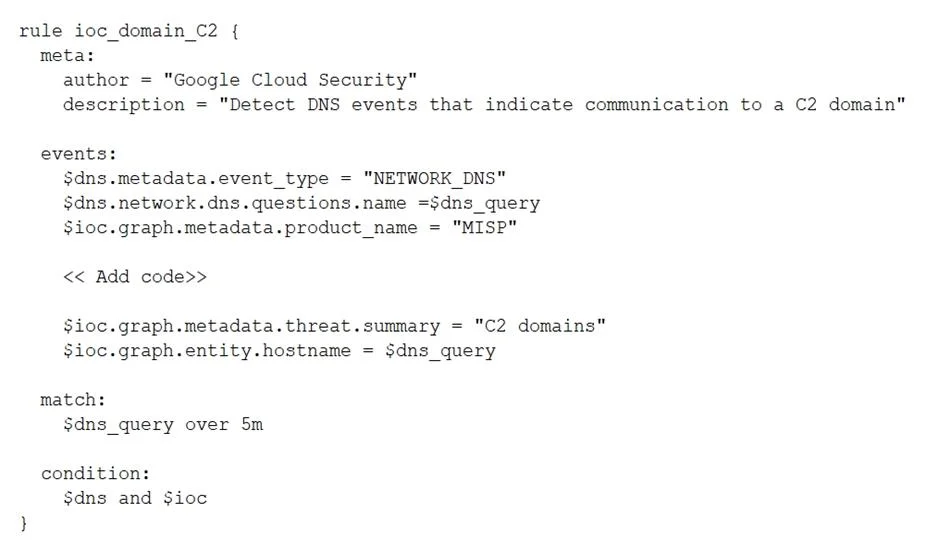
You are implementing Google Security Operations (SecOps) for your organization. Your organization has their own threat intelligence feed that has been ingested to Google SecOps by using a native…
The correct answer is A. $ioc.graph.metadata.entity_type = "DOMAIN_NAME". This code ensures your rule matches IOCs classified as domain names and sourced directly as entity context from MISP, allowing precise correlation between DNS queries and known C2
Question
You are implementing Google Security Operations (SecOps) for your organization. Your organization has their own threat intelligence feed that has been ingested to Google SecOps by using a native integration with a Malware Information Sharing Platform (MISP). You are working on the following detection rule to leverage the command and control (C2) indicators that were ingested into the entity graph. What code should you add in the detection rule to filter for the domain IOCs?
Exhibit
Options
- A$ioc.graph.metadata.entity_type = "DOMAIN_NAME"
- B$ioc.graph.metadata.entity_type = "DOMAIN_NAME"
- C$ioc.graph.metadata.entity_type = "DOMAIN_NAME"
- D$ioc.graph.metadata.entity_type = "DOMAIN_NAME"
How the community answered
(28 responses)- A79% (22)
- B14% (4)
- C4% (1)
- D4% (1)
Explanation
This code ensures your rule matches IOCs classified as domain names and sourced directly as entity context from MISP, allowing precise correlation between DNS queries and known C2
Topics
Community Discussion
No community discussion yet for this question.