
PROFESSIONAL-DATA-ENGINEER · Question #47
You are deploying a new storage system for your mobile application, which is a media streaming service. You decide the best fit is Google Cloud Datastore. You have entities with multiple properties…
The correct answer is A. Option A. The specific text for Options A–D wasn't included in the question (each is just labeled "Option A/B/C/D"), so a precise per-option breakdown isn't possible. That said, here is the core concept the question is testing: The correct approach (Option A) is to use separate composite…
Question
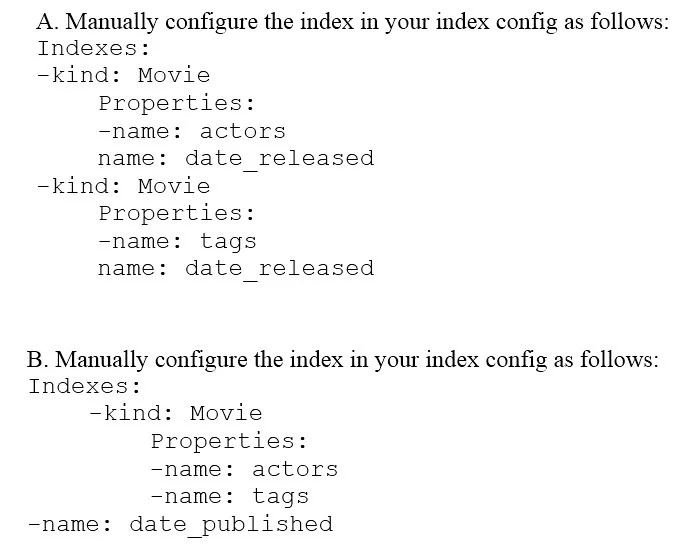
Movie' the property actors' and the property tags' have multiple values but the property date released' does not. A typical query would ask for all movies with actor=<actorname> ordered by date_released or all movies with tag=Comedy ordered by date_released. How should you avoid a combinatorial explosion in the number of indexes?Exhibit
Options
- AOption A
- BOption B.
- COption C
- DOption D
How the community answered
(17 responses)- A71% (12)
- B18% (3)
- C6% (1)
- D6% (1)
Explanation
The specific text for Options A–D wasn't included in the question (each is just labeled "Option A/B/C/D"), so a precise per-option breakdown isn't possible. That said, here is the core concept the question is testing:
The correct approach (Option A) is to use separate composite indexes per query pattern - one on (actors, date_released) and one on (tags, date_released) - rather than a single composite index spanning all multi-valued properties together.
Why combinatorial explosion happens: Cloud Datastore writes one index row per combination of values. If a movie has 5 actors and 4 tags, a composite index on (actors, tags, date_released) would write 5 × 4 = 20 entries just for that one entity. With large multi-valued properties, this multiplies into an unmanageable number of index entries.
The fix: Keep multi-valued properties in separate composite indexes tied to the specific query they serve. Queries that filter on only one multi-valued property at a time (actors OR tags, not both) don't trigger cross-multiplication.
Distractors typically suggest creating one index covering all properties at once, indexing every property individually with no composite structure, or disabling indexes entirely - all of which either cause the explosion, miss query support, or break filtering.
Memory tip: Think "one multi-valued property per composite index." The moment two multi-valued properties share an index, entries multiply - like a combinatorial Cartesian product.
Topics
Community Discussion
No community discussion yet for this question.