
PROFESSIONAL-CLOUD-NETWORK-ENGINEER · Question #144
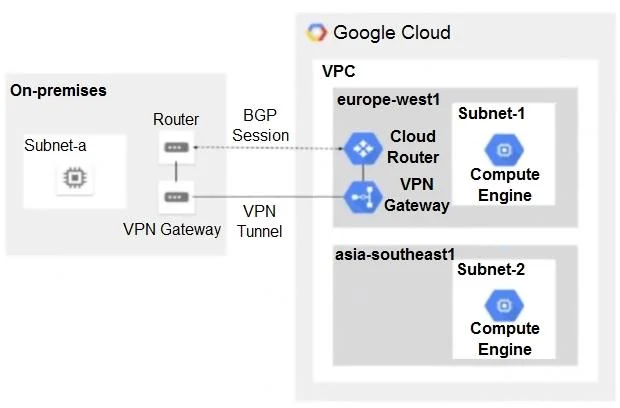
You have the following routing design. You discover that Compute Engine instances in Subnet-2 in the asia-southeast1 region cannot communicate with compute resources on-premises. What should you do?
The correct answer is C. Change the VPC dynamic routing mode to Global. In the default Regional dynamic routing mode, a Cloud Router only propagates learned BGP routes (from on-premises) to subnets within its own region. If the Cloud Router and VPN gateway are in a different region than asia-southeast1, the on-premises routes will not be…
Question
Exhibit
Options
- AConfigure a custom route advertisement on the Cloud Router.
- BEnable IP forwarding in the asia-southeast1 region.
- CChange the VPC dynamic routing mode to Global.
- DAdd a second Border Gateway Protocol (BGP) session to the Cloud Router.
How the community answered
(32 responses)- A13% (4)
- B9% (3)
- C75% (24)
- D3% (1)
Explanation
In the default Regional dynamic routing mode, a Cloud Router only propagates learned BGP routes (from on-premises) to subnets within its own region. If the Cloud Router and VPN gateway are in a different region than asia-southeast1, the on-premises routes will not be distributed to instances in Subnet-2 in asia-southeast1, causing the connectivity failure. Switching to Global dynamic routing mode causes the Cloud Router to advertise all VPC subnets to on-premises and distribute all learned on-premises routes to all regions across the entire VPC, resolving the issue. Option A would not fix the problem since the BGP sessions are presumably already advertising the correct routes. Option B (IP forwarding) enables VMs to act as routers, which is unrelated to this issue. Option D adding a second BGP session does not fix regional route propagation.
Topics
Community Discussion
No community discussion yet for this question.