
PL-500 · Question #91
Drag and Drop Question A company plans to implement AI models to perform business processes. You need to determine whether to use prebuilt or custom AI models. Which type of model should you use for…
The correct answer is Prebuilt; Custom; Prebuilt; Custom. This question assesses the test-taker's understanding of when to use prebuilt versus custom AI models for various business process automation scenarios.
Question
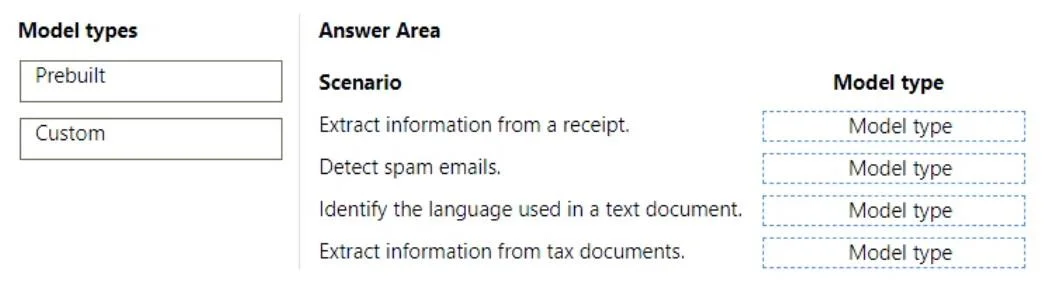
Drag and Drop Question A company plans to implement AI models to perform business processes. You need to determine whether to use prebuilt or custom AI models. Which type of model should you use for each scenario? To answer, drag the appropriate model types to the correct scenarios. Each model may be used once, more than once, or not at all. You may need to drag the split bar between panes or scroll to view content. NOTE: Each correct selection is worth one point. Answer:
Exhibit
Answer Area
Drag items
Correct arrangement
- Prebuilt
- Custom
- Prebuilt
- Custom
Explanation
This question assesses the test-taker's understanding of when to use prebuilt versus custom AI models for various business process automation scenarios.
Approach. The correct approach involves dragging the appropriate model type ('Prebuilt' or 'Custom') to each scenario based on the typical availability and suitability of Azure AI services and general AI model development practices.
-
Extract information from a receipt: This is a common and well-defined task. Services like Azure AI Document Intelligence (formerly Form Recognizer) offer robust prebuilt models specifically for receipts, capable of extracting key-value pairs (e.g., merchant name, total, date) without custom training. Therefore, 'Prebuilt' is the correct choice.
-
Detect spam emails: While email services often have built-in spam filters (which are 'prebuilt' from an end-user perspective), if a company intends to implement AI models for this purpose, especially to handle specific internal patterns, evolving threats, or integrate into a custom application, it often requires training a classification model on their own datasets. There isn't a universally generic 'spam detection' prebuilt API offered by platforms like Azure AI in the same way as language detection or receipt processing. Thus, 'Custom' is typically needed for tailored, enterprise-specific spam detection.
-
Identify the language used in a text document: This is a fundamental Natural Language Processing (NLP) task that is highly standardized. Services like Azure AI Language provide highly accurate prebuilt models for language detection across numerous languages, requiring no custom training. Therefore, 'Prebuilt' is the correct choice.
-
Extract information from tax documents: Tax documents are highly variable, often complex, and specific to regions, forms, and regulations. While optical character recognition (OCR) can be applied, extracting specific structured information reliably from a diverse set of tax forms almost always requires custom training, for example, using Azure AI Document Intelligence's custom model capabilities where users label their specific documents. Therefore, 'Custom' is the correct choice.
Common mistakes.
- common_mistake. A common mistake is incorrectly identifying which tasks are generic enough for prebuilt models versus those requiring specific domain knowledge and custom training. For instance, assuming all document processing (like tax documents) can be handled by a generic prebuilt model, or conversely, believing that common NLP tasks (like language detection) always require custom development. Misinterpreting 'Detect spam emails' as a task solvable by a generic prebuilt API (similar to how prebuilt services for sentiment analysis exist) without considering the need for enterprise-specific, evolving threat patterns, would lead to incorrectly selecting 'Prebuilt' instead of 'Custom'. Another error would be selecting 'Custom' for receipts, neglecting the widely available and highly effective prebuilt models designed for them.
Concept tested. The core concept being tested is the ability to differentiate between prebuilt AI models (off-the-shelf, general-purpose services that solve common problems with minimal setup) and custom AI models (requiring specific data, training, and fine-tuning to address unique or highly specialized business needs). This includes knowledge of typical use cases for various Azure AI services like Azure AI Document Intelligence and Azure AI Language.
Topics
Community Discussion
No community discussion yet for this question.