
PL-400 · Question #382
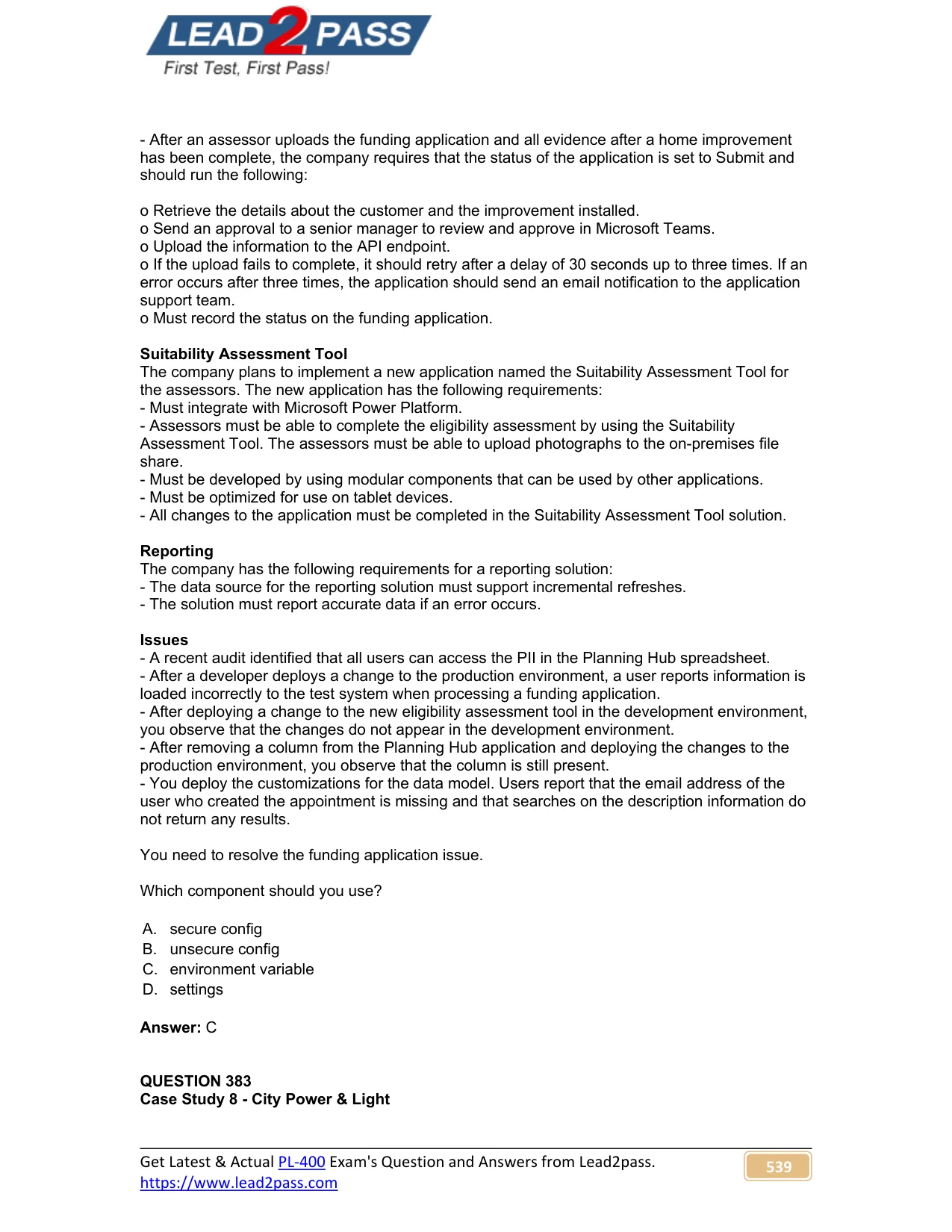
Case Study 8 - City Power & Light Background City Power & Light is an energy and utilities company that has offices in Europe. The company subsidizes home improvements for domestic customers, to…
The correct answer is C. environment variable. Environment variables are a standard practice for managing configuration settings in cloud applications, enabling flexible and secure deployment across different environments.
Question
Exhibit
Options
- Asecure config
- Bunsecure config
- Cenvironment variable
- Dsettings
How the community answered
(35 responses)- A14% (5)
- B9% (3)
- C74% (26)
- D3% (1)
Why each option
Environment variables are a standard practice for managing configuration settings in cloud applications, enabling flexible and secure deployment across different environments.
"Secure config" is a general goal; environment variables can be part of a secure configuration strategy, but it's not a specific mechanism like environment variables.
"Unsecure config" describes a state, not a recommended method for managing configuration parameters.
Environment variables provide a robust and flexible mechanism to store configuration values that can change between deployment environments, such as connection strings or API keys, without hardcoding them into the application itself. They are easily managed and accessed by applications running in various cloud services.
"Settings" is a generic term, while "environment variable" refers to a specific and widely used implementation for managing application configurations, especially in cloud scenarios.
Concept tested: Application configuration management (environment variables)
Source: https://learn.microsoft.com/en-us/azure/azure-functions/functions-how-to-use-azure-function-app-settings?tabs=portal%2Cwindows&pivots=programming-language-csharp#application-settings
Community Discussion
No community discussion yet for this question.