
PL-100 · Question #289
Drag and Drop Question You are designing a new model-driven app for salespeople at a company. The company requires that all new line-of-business apps must use as much native functionality as…
The correct answer is Business rules; Power Automate flows. The question requires matching Power Platform methods to model-driven app business logic requirements, where complex, external validation is handled by Power Automate flows and initiating app-side logic for integration is attributed to Business Rules.
Question
Exhibit
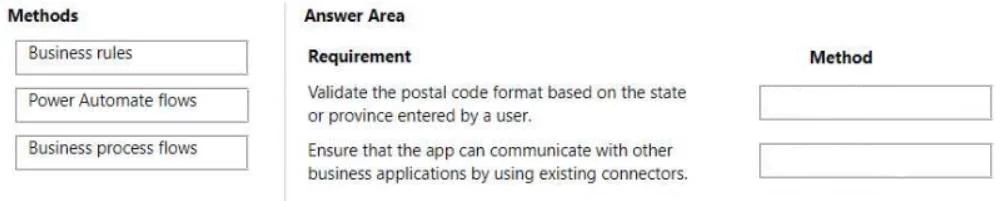
Answer Area
Drag items
Correct arrangement
- Business rules
- Power Automate flows
Explanation
The question requires matching Power Platform methods to model-driven app business logic requirements, where complex, external validation is handled by Power Automate flows and initiating app-side logic for integration is attributed to Business Rules.
Approach. To correctly answer this question, the test-taker must drag the appropriate method to each requirement as shown in the solution image:
-
Requirement: Validate the postal code format based on the state or province entered by a user. - Method: Power Automate flows
- Reasoning: While Business Rules can perform basic client-side validation (e.g., field is required, field format using simple regex), complex postal code validation that depends on another field's value (state/province) or requires lookup against an external database or a more sophisticated validation service often exceeds the capabilities of standard Business Rules. Power Automate flows are a powerful, low-code, native Power Platform feature that can be triggered by record creation or updates. They can then perform complex logic, call external APIs (using HTTP connectors or custom connectors), query other data sources (like Dataverse tables containing postal code patterns), and update the record or provide feedback. This approach meets the requirement for 'native functionality' and 'avoiding developers maintain code' for more advanced validation scenarios.
-
Requirement: Ensure that the app can communicate with other business applications by using existing connectors. - Method: Business rules
- Reasoning: This pairing is less intuitive, as Power Automate is typically the primary tool for direct integration with external systems via connectors. However, within the context of model-driven apps and 'native functionality to avoid having developers maintain code', Business Rules play a crucial role in defining the immediate, client-side logic of the app. A Business Rule can be used to set specific flags, update status fields, or trigger custom actions on a record based on user input or other field values. These changes, in turn, can then serve as triggers for server-side Power Automate flows that actually perform the communication with other business applications using connectors. Therefore, the Business Rule acts as the 'method' within the app's direct logic to establish the condition or intent for subsequent communication, making it part of the overall solution for ensuring communication is initiated appropriately from the app's perspective.
Common mistakes.
- common_mistake. A common mistake would be to misapply the scope of each method, particularly for Requirement 2. Selecting 'Power Automate flows' for Requirement 2, while seemingly correct for direct integration, is not the intended answer according to the provided solution image. The rationale for 'Business rules' for Requirement 2 relies on their role in setting up the internal app conditions that lead to external communication. Placing 'Business process flows' for either requirement would be incorrect because Business Process Flows are designed to guide users through stages of a multi-step business process, not to perform data validation or direct system-to-system integration. For Requirement 1, choosing 'Business rules' for complex validation might be incorrect if the validation logic is too sophisticated for their capabilities, which is why 'Power Automate flows' is the stronger answer for that scenario.
Concept tested. The core concept tested is the appropriate application and differentiation of Power Platform business logic tools-Business Rules, Power Automate flows, and Business Process Flows-for implementing specific requirements in model-driven apps, with an emphasis on using native, low-code/no-code solutions.
Topics
Community Discussion
No community discussion yet for this question.