
PCNSE7 · Question #1
A company.com wants to enable Application Override. Given the following screenshot: Which two statements are true if Source and Destination traffic match the Application Override policy? (Choose two)
The correct answer is C. Traffic utilizing UDP Port 16384 will now be identified as "rtp-base". D. Traffic utilizing UDP Port 16384 will bypass the App-ID and Content-ID engines. An application override policy is changes how the Palo Alto Networks firewall classifies network traffic into applications. An application override with a custom application prevents the session from being processed by the App-ID engine, which is a Layer-7 inspection…
Question
A company.com wants to enable Application Override. Given the following screenshot:
Which two statements are true if Source and Destination traffic match the Application Override policy? (Choose two)
Exhibit
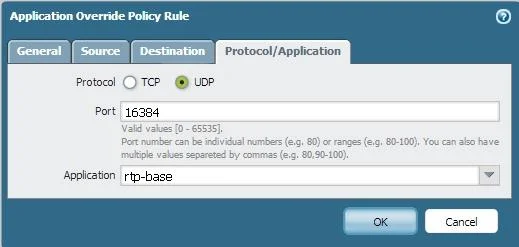
Options
- ATraffic that matches "rtp-base" will bypass the App-ID and Content-ID engines.
- BTraffic will be forced to operate over UDP Port 16384.
- CTraffic utilizing UDP Port 16384 will now be identified as "rtp-base".
- DTraffic utilizing UDP Port 16384 will bypass the App-ID and Content-ID engines.
How the community answered
(66 responses)- A11% (7)
- B6% (4)
- C83% (55)
Explanation
An application override policy is changes how the Palo Alto Networks firewall classifies network traffic into applications. An application override with a custom application prevents the session from being processed by the App-ID engine, which is a Layer-7 inspection. https://live.paloaltonetworks.com/t5/Configuration-Articles/How-to-Create-an-Application- Override-Policy/ta-p/60044
Topics
Community Discussion
No community discussion yet for this question.