
PCNSE · Question #271
An administrator just submitted a newly found piece of spyware for WildFire analysis. The spyware monitors behavior without the user's knowledge. What is the expected verdict from WildFire?
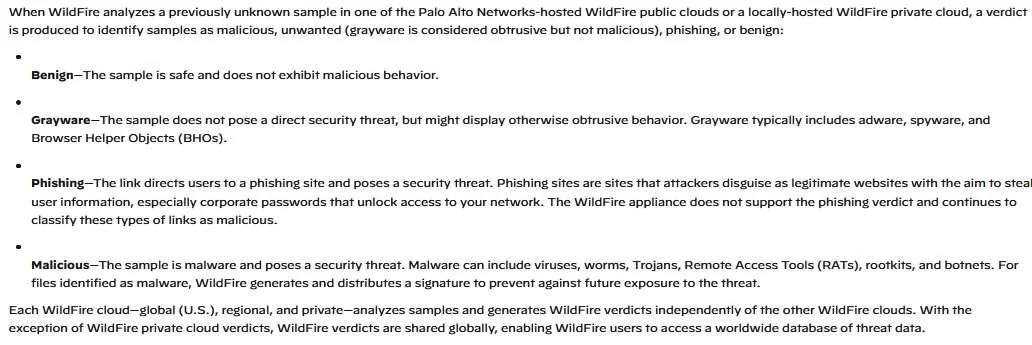
The correct answer is B. Grayware. WildFire uses a specific verdict taxonomy. 'Malware' applies to overtly malicious files such as viruses, ransomware, and trojans. 'Grayware' is the verdict assigned to Potentially Unwanted Applications (PUAs) - software that is not outright malicious but exhibits unwanted…
Question
An administrator just submitted a newly found piece of spyware for WildFire analysis. The spyware monitors behavior without the user's knowledge. What is the expected verdict from WildFire?
Exhibit
Options
- AMalware
- BGrayware
- CPhishing
- DSpyware
How the community answered
(47 responses)- A4% (2)
- B91% (43)
- C2% (1)
- D2% (1)
Explanation
WildFire uses a specific verdict taxonomy. 'Malware' applies to overtly malicious files such as viruses, ransomware, and trojans. 'Grayware' is the verdict assigned to Potentially Unwanted Applications (PUAs) - software that is not outright malicious but exhibits unwanted behavior, such as adware, browser hijackers, and spyware that monitors user activity without explicit consent. Because the described spyware monitors behavior without the user's knowledge (a PUA characteristic rather than a direct destructive or exfiltration payload), WildFire classifies it as Grayware, not Malware. 'Phishing' and 'Spyware' are not standalone WildFire verdict categories.
Topics
Community Discussion
No community discussion yet for this question.