
PCNSA · Question #181
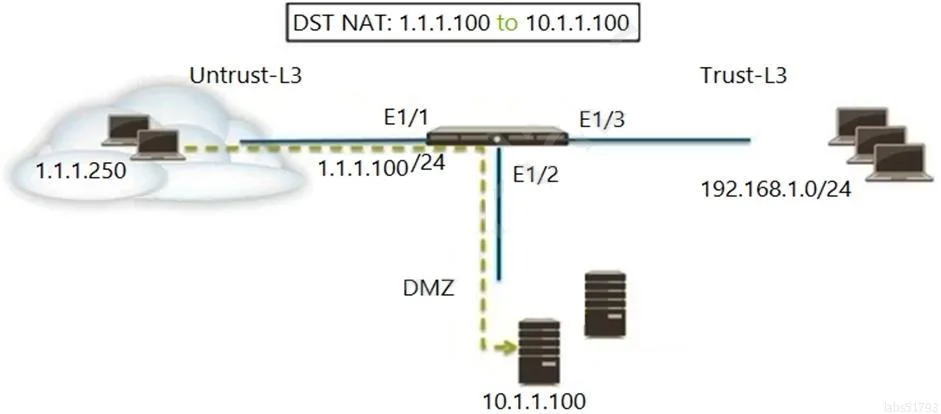
Refer to the exhibit. A web server in the DMZ is being mapped to a public address through DNAT. Which Security policy rule will allow traffic to flow to the web server?
The correct answer is D. Untrust (any) to DMZ (1.1.1.100), web browsing -Allow. When Destination NAT (DNAT) is configured on a Palo Alto Networks firewall, Security policy evaluation uses the pre-NAT destination IP address but the post-NAT destination zone. Traffic arrives from the Untrust zone destined for the public IP 1.1.1.100; the firewall's route…
Question
Refer to the exhibit. A web server in the DMZ is being mapped to a public address through DNAT. Which Security policy rule will allow traffic to flow to the web server?
Exhibit
Options
- AUntrust (any) to DMZ (10.1.1.100), web browsing -Allow
- BUntrust (any) to Untrust (1.1.1.100), web browsing -Allow
- CUntrust (any) to Untrust (10.1.1.100), web browsing -Allow
- DUntrust (any) to DMZ (1.1.1.100), web browsing -Allow
How the community answered
(24 responses)- A17% (4)
- B4% (1)
- C4% (1)
- D75% (18)
Explanation
When Destination NAT (DNAT) is configured on a Palo Alto Networks firewall, Security policy evaluation uses the pre-NAT destination IP address but the post-NAT destination zone. Traffic arrives from the Untrust zone destined for the public IP 1.1.1.100; the firewall's route lookup for the translated address (10.1.1.100) determines the egress zone is DMZ. Therefore the Security policy rule must specify: source zone = Untrust, destination zone = DMZ (post-NAT zone), and destination address = 1.1.1.100 (pre-NAT public IP). Option D is the only choice that correctly pairs the DMZ zone with the pre-NAT public IP.
Topics
Community Discussion
No community discussion yet for this question.