
PCCSA · Question #4
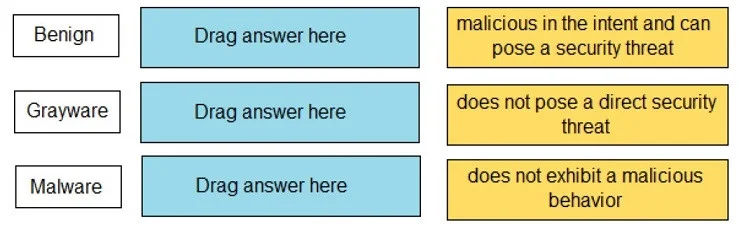
Match the Palo Alto Networks Wild Fire analysis verdict with its definition.
WildFire Analysis Verdicts - Explanation > Note: The options field appears empty ({}), so I'll cover all standard WildFire verdicts based on the official Palo Alto Networks curriculum. --- Overview WildFire is Palo Alto Networks' cloud-based threat intelligence and sandbox…
Question
Exhibit
Explanation
WildFire Analysis Verdicts - Explanation
Note: The options field appears empty (
{}), so I'll cover all standard WildFire verdicts based on the official Palo Alto Networks curriculum.
Overview
WildFire is Palo Alto Networks' cloud-based threat intelligence and sandbox service. It analyzes unknown files and URLs by executing them in a safe environment and observing behavior. After analysis, WildFire assigns a verdict - a classification that tells the firewall how to treat the sample going forward.
Understanding verdicts is critical because they drive automated policy enforcement: signatures are generated and pushed to all WildFire subscribers within minutes.
The Four WildFire Verdicts
1. Benign
- Definition: The sample is safe. It exhibits no malicious or suspicious behavior.
- Why it matters: The file is allowed to pass. No signature is created.
- Key point: Even benign files are logged, giving visibility into what enters your network.
2. Malware
- Definition: The sample is definitively malicious - it performs harmful actions like exfiltration, code execution, persistence, or C2 communication.
- Why it matters: A new signature is automatically generated and distributed to all Palo Alto Networks devices globally (typically within 5 minutes for WildFire cloud). The file is blocked on future encounters.
- Key point: This is the verdict that triggers the most immediate, widest defensive response.
3. Grayware
- Definition: The sample is not overtly malicious but exhibits unwanted or potentially undesirable behavior - adware, spyware, browser hijackers, hacking tools, or Potentially Unwanted Programs (PUPs).
- Why it matters: Grayware doesn't rise to the level of malware but still represents risk. Organizations can choose whether to block it via policy.
- Key point: Grayware is a judgment call - it may be legitimate software in one context and a policy violation in another (e.g., a network scanner tool).
4. Phishing
- Definition: The sample (typically a URL or page) is designed to deceive users into surrendering credentials or personal information by impersonating a trusted entity.
- Why it matters: Phishing verdicts apply primarily to URLs analyzed by WildFire (not just files). The URL is blocked and added to the PAN-DB URL database.
- Key point: Phishing is credential-theft focused - distinct from malware, which focuses on code execution.
Why This Classification Matters (The Procedure Logic)
| Verdict | Threat Level | Signature Created? | Action |
|---|---|---|---|
| Benign | None | No | Allow |
| Grayware | Low–Medium | Yes (grayware sig) | Allow or Block (policy-dependent) |
| Phishing | Medium–High | Yes (URL category) | Block URL |
| Malware | High | Yes (antivirus sig) | Block file |
The verdicts feed back into three enforcement mechanisms:
- Antivirus signatures (for Malware)
- Grayware signatures (for Grayware)
- PAN-DB URL categories (for Phishing)
What Goes Wrong Without This System
- Without WildFire verdicts, unknown files would pass through uninspected - zero-day malware would enter freely.
- Without the Grayware category, borderline software would force a binary benign/malware decision, causing either false positives or missed risks.
- Without Phishing as a distinct verdict, credential-theft URLs might only be caught if they also deliver a malicious payload - many phishing pages deliver no malware at all.
Memory Tip
"B-G-M-P" → "Be Careful My Password"
- Benign → safe
- Grayware → gray area (unwanted, not overtly evil)
- Malware → malicious code/execution
- Phishing → password/credential theft
Severity goes: Benign < Grayware < Phishing < Malware (in terms of immediate threat to system integrity).
Topics
Community Discussion
No community discussion yet for this question.