
OGBA-101 · Question #15
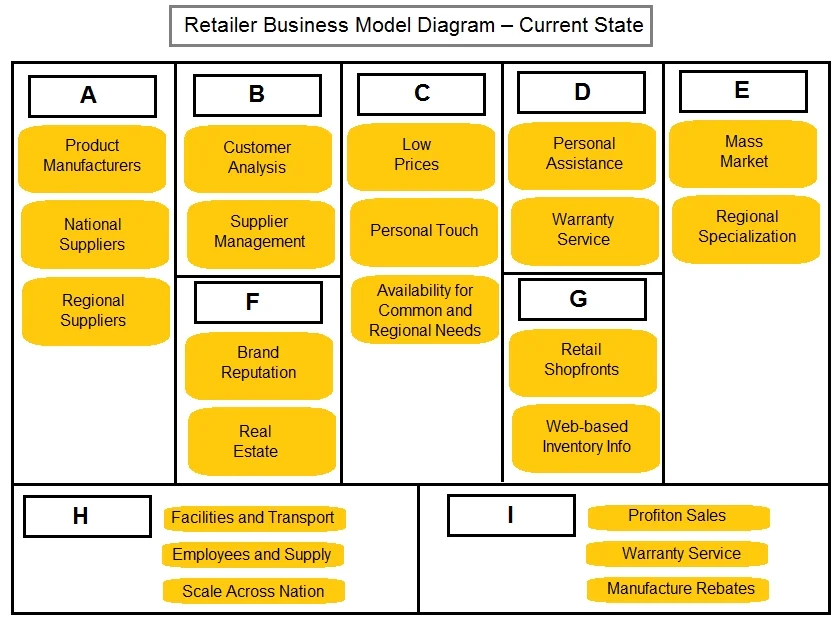
Consider the following example using the Business Model Canvas: What are the segments labeled A, D and I?
The correct answer is C. Key Partners, Customer Relationships, Revenue Streams. The segments labeled A, D and I in the Business Model Canvas are Key Partners, Customer Relationships, and Revenue Streams respectively. The Business Model Canvas is a tool that can be used to describe how an organization creates, delivers, and captures value for its…
Question
Consider the following example using the Business Model Canvas:
What are the segments labeled A, D and I?
Exhibit
Options
- ACustomer Relationships, Value Propositions, Market Segments.
- BCustomer Segments, Value Add Services, Profit Channels.
- CKey Partners, Customer Relationships, Revenue Streams.
- DKey Resources, Revenue Streams, Cost Structure
How the community answered
(36 responses)- A17% (6)
- B6% (2)
- C69% (25)
- D8% (3)
Explanation
The segments labeled A, D and I in the Business Model Canvas are Key Partners, Customer Relationships, and Revenue Streams respectively. The Business Model Canvas is a tool that can be used to describe how an organization creates, delivers, and captures value for its stakeholders. The Business Model Canvas consists of nine segments that cover four main areas: customers (segments B,C,D), offer (segment E), infrastructure (segments A,F,G), and financial viability (segments H,I). The segments are defined as follows: Key Partners (segment A): The network of suppliers and partners that make the business model work. Key partners can provide resources, activities, or support that enable the organization to offer its value proposition. Customer Relationships (segment D): The type of relationship that the organization establishes with its customer segments. Customer relationships can be driven by customer acquisition, retention, or loyalty objectives. Customer relationships can also influence the customer experience and satisfaction. Revenue Streams (segment I): The sources of income that the organization generates from each customer segment. Revenue streams can be derived from different pricing mechanisms, such as asset sale, subscription, fee, commission, or advertising. Revenue streams can also reflect the value that customers are willing to pay for the organization's offer.
Topics
Community Discussion
No community discussion yet for this question.