
NSE7_SDW-7.2 · Question #6
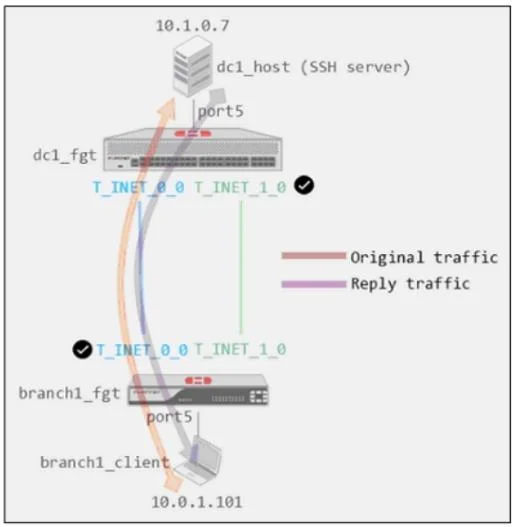
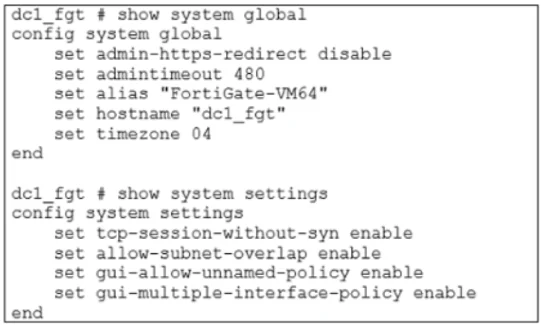
Refer to the exhibits. Exhibit A Exhibit B Exhibit A shows a site-to-site topology between two FortiGate devices: branch1_fgt and dc1_fgt. Exhibit B shows the system global and system settings…
The correct answer is A. Enable auxiliary-session under config system settings. Controlling return path with auxiliary session When multiple incoming or outgoing interfaces are used in ECMP or for load balancing, changes to routing, incoming, or return traffic interfaces impacts how an existing sessions handles the traffic. Auxiliary sessions can be used…
Question
Refer to the exhibits. Exhibit A Exhibit B Exhibit A shows a site-to-site topology between two FortiGate devices: branch1_fgt and dc1_fgt. Exhibit B shows the system global and system settings configuration on dc1_fgt. When branch1_client establishes a connection to dc1_host, the administrator observes that, on dc1_fgt, the reply traffic is routed over T_INET_0_0, even though T_INET_1_0 is the preferred member in the matching SD-WAN rule. Based on the information shown in the exhibits, what configuration change must be made on dc1_fgt so dc1_fgt routes the reply traffic over T_INET_1_0?
Exhibits
Options
- AEnable auxiliary-session under config system settings.
- BDisable tcp-session-without-syn under config system settings.
- CEnable snat-route-change under config system global.
- DDisable allow-subnet-overlap under config system settings.
How the community answered
(36 responses)- A78% (28)
- B3% (1)
- C8% (3)
- D11% (4)
Explanation
Controlling return path with auxiliary session When multiple incoming or outgoing interfaces are used in ECMP or for load balancing, changes to routing, incoming, or return traffic interfaces impacts how an existing sessions handles the traffic. Auxiliary sessions can be used to handle these changes to traffic patterns.
Topics
Community Discussion
No community discussion yet for this question.