
NSE4_FGT-7.0 · Question #183
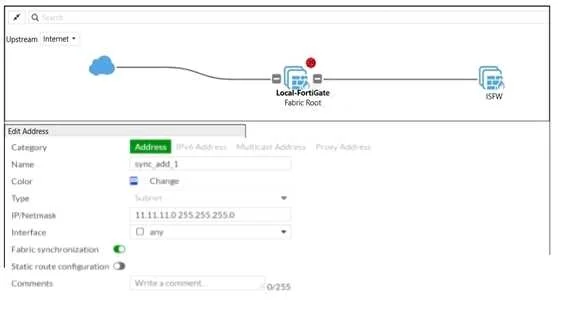
Refer to the exhibits. An administrator creates a new address object on the root FortiGate (Local- FortiGate) in the security fabric. After synchronization, this object is not available on the…
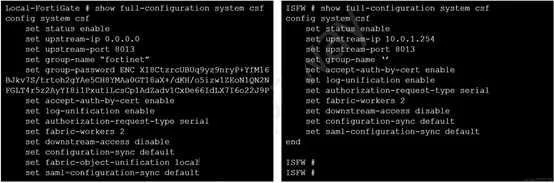
The correct answer is A. Change the csf setting on Local-FortiGate (root) to sec configuration-sync local. To synchronize an address object created on the root FortiGate to a downstream FortiGate in a security fabric, the root FortiGate's 'configuration-sync' setting must be set to 'local'.
Question
Refer to the exhibits. An administrator creates a new address object on the root FortiGate (Local- FortiGate) in the security fabric. After synchronization, this object is not available on the downstream FortiGate (ISFW). Exhibit A. Exhibit B. What must the administrator do to synchronize the address object?
Exhibits
Options
- AChange the csf setting on Local-FortiGate (root) to sec configuration-sync local.
- BChange the csf setting on ISFW (downstream) to sec configuracion-sync local.
- CChange the csf setting on Local-FortiGate (root) to sec fabric-objecc-unificacion defaulc.
- DChange the csf setting on ISFW (downstream) to sec fabric-objecc-unificacion defaulc.
How the community answered
(24 responses)- A83% (20)
- B4% (1)
- C8% (2)
- D4% (1)
Why each option
To synchronize an address object created on the root FortiGate to a downstream FortiGate in a security fabric, the root FortiGate's 'configuration-sync' setting must be set to 'local'.
For a root FortiGate in a Security Fabric to push its local configuration changes, including newly created address objects, to its fabric members, the `config system csf` setting `set configuration-sync local` must be enabled on the root device. This ensures that the root's local configuration is synchronized with downstream FortiGates.
Changing the `configuration-sync` setting on the downstream FortiGate affects its behavior, not the root's ability to push objects to it.
The `fabric-object-unification` setting on the root FortiGate relates to how objects are consolidated or managed across the fabric, not the primary control for synchronizing new objects from root to downstream.
Adjusting `fabric-object-unification` on the downstream FortiGate does not enable the root FortiGate to synchronize its newly created address objects.
Concept tested: FortiGate Security Fabric configuration synchronization
Source: https://docs.fortinet.com/document/fortigate/7.4.0/administration-guide/918361/configuring-the-security-fabric
Topics
Community Discussion
No community discussion yet for this question.