
NSE4 · Question #550
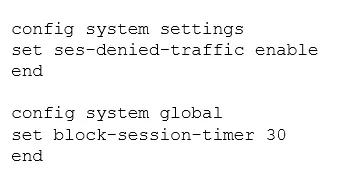
An administrator has configured the following settings: What does the configuration do? (Choose two.)
The correct answer is A. Reduces the amount of logs generated by denied traffic. D. Creates a session for traffic being denied. This FortiGate configuration reduces the amount of logs generated by denied traffic by creating a session for such traffic, which prevents repeated logging of individual denied packets.
Question
An administrator has configured the following settings:
What does the configuration do? (Choose two.)
Exhibit
Options
- AReduces the amount of logs generated by denied traffic.
- BEnforces device detection on all interfaces for 30 minutes.
- CBlocks denied users for 30 minutes.
- DCreates a session for traffic being denied.
How the community answered
(35 responses)- A94% (33)
- B3% (1)
- C3% (1)
Why each option
This FortiGate configuration reduces the amount of logs generated by denied traffic by creating a session for such traffic, which prevents repeated logging of individual denied packets.
By enabling the creation of sessions for denied traffic, the FortiGate avoids generating a new log entry for every individual packet that is part of a continuously denied connection, thereby significantly reducing the overall log volume.
There is no direct correlation between reducing logs for denied traffic and enforcing device detection on interfaces for a specific duration.
While traffic might be denied, creating a session for denied traffic does not inherently block users for a specified duration like a quarantine or ban.
A 'deny session' is a specific FortiGate feature where, instead of dropping individual packets and logging each one separately, a session is created to track denied traffic. This allows the FortiGate to subsequently drop further packets of that same connection silently without generating redundant logs.
Concept tested: FortiGate Deny Session and Logging Reduction
Source: https://docs.fortinet.com/document/fortigate/7.4.0/administration-guide/469902/session-handling
Topics
Community Discussion
No community discussion yet for this question.