
NSE4 · Question #40
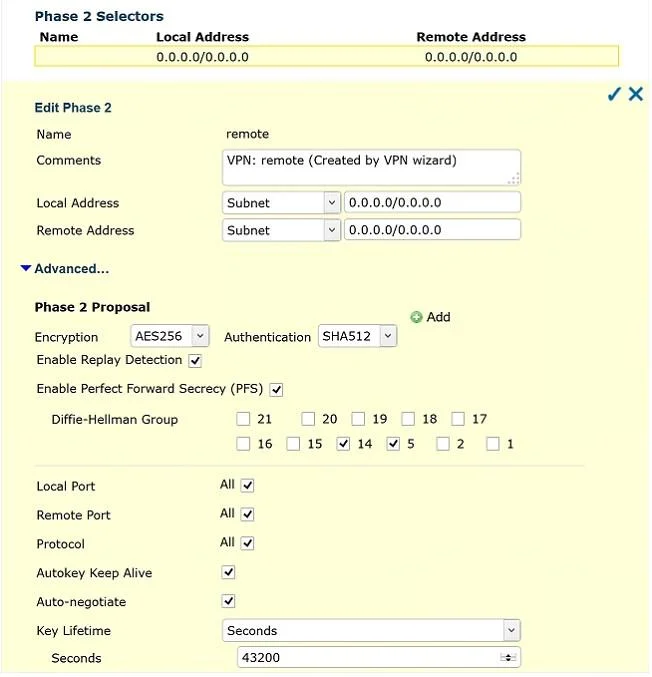
Review the IPsec phase 2 configuration shown in the exhibit; then answer the question below. Which statements are correct regarding this configuration? (Choose two.).
The correct answer is A. The Phase 2 will re-key even if there is no traffic. B. There will be a DH exchange for each re-key. In IPsec Phase 2, if auto-negotiate is enabled, the security association will re-key based on its lifetime even without traffic, and with Perfect Forward Secrecy (PFS) enabled, a new Diffie-Hellman exchange occurs for each re-key.
Question
Review the IPsec phase 2 configuration shown in the exhibit; then answer the question below. Which statements are correct regarding this configuration? (Choose two.).
Exhibit
Options
- AThe Phase 2 will re-key even if there is no traffic.
- BThere will be a DH exchange for each re-key.
- CThe sequence number of ESP packets received from the peer will not be checked.
- DQuick mode selectors will default to those used in the firewall policy.
How the community answered
(35 responses)- A86% (30)
- C6% (2)
- D9% (3)
Why each option
In IPsec Phase 2, if auto-negotiate is enabled, the security association will re-key based on its lifetime even without traffic, and with Perfect Forward Secrecy (PFS) enabled, a new Diffie-Hellman exchange occurs for each re-key.
If 'Auto-negotiate' or 'Enable Keep Alive' is configured in Phase 2, the FortiGate will actively maintain the tunnel by performing re-keys based on the configured lifetime (e.g., time or bytes), irrespective of actual data traffic.
When Perfect Forward Secrecy (PFS) is enabled in Phase 2, each re-key operation mandates a new Diffie-Hellman key exchange, ensuring that a compromise of one session key does not compromise past or future keys.
Anti-replay protection, which involves checking the sequence numbers of ESP packets, is a standard and typically enabled security feature in IPsec Phase 2 to prevent replay attacks, unless explicitly disabled.
Quick mode selectors (local/remote subnets, ports, protocols) are explicitly defined in the Phase 2 configuration or derived from firewall policy matching, rather than simply 'defaulting' to those in the firewall policy.
Concept tested: FortiGate IPsec Phase 2 configuration, re-keying, PFS
Source: https://docs.fortinet.com/document/fortigate/7.4.0/administration-guide/52671/ipsec-vpn
Topics
Community Discussion
No community discussion yet for this question.