
NS0-158 · Question #17
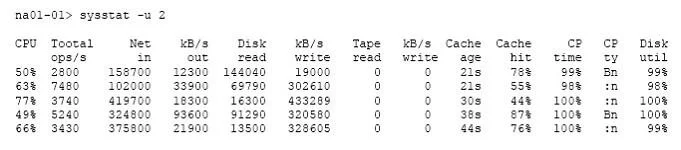
Click the Exhibit button. You are receiving reports of high storage latency from the database administrators. The NetApp storage system is connected to the network using 10 Gb. You run the sysstat…
The correct answer is B. The system is experiencing a disk bottleneck. High storage latency often indicates a bottleneck at the disk level in a NetApp system, even with a high-bandwidth network. The sysstat command's output, showing high disk utilization, directly points to this issue.
Question
Click the Exhibit button. You are receiving reports of high storage latency from the database administrators. The NetApp storage system is connected to the network using 10 Gb. You run the sysstat command as shown in the exhibit. In this scenario, why is storage latency high?
Exhibit
Options
- AThe system does not have enough cache.
- BThe system is experiencing a disk bottleneck.
- CThe CPU usage is too high.
- DThe network interfaces are maximized out.
How the community answered
(46 responses)- A20% (9)
- B46% (21)
- C9% (4)
- D26% (12)
Why each option
High storage latency often indicates a bottleneck at the disk level in a NetApp system, even with a high-bandwidth network. The `sysstat` command's output, showing high disk utilization, directly points to this issue.
While insufficient cache can contribute to latency by increasing disk I/O, a 'disk bottleneck' specifically identifies the disks themselves as the ultimate constraint, which is a more direct cause if `sysstat` shows high disk busy rates.
A disk bottleneck occurs when the physical disks cannot keep up with the I/O requests, leading to increased response times and high latency. The `sysstat` command often displays disk utilization percentages (e.g., '%busy'), and if these values are consistently high, it points directly to the disks as the source of the latency, indicating they are operating at or near their maximum capacity.
High CPU usage can impact performance, but `sysstat` output would show high CPU utilization percentages; if disk utilization is the primary issue, then the CPU is not the bottleneck in this specific scenario.
The problem states a 10 Gb network, which is generally high bandwidth, and `sysstat` would show network interface saturation (e.g., high utilization on network ports) if this were the issue, but the question points to storage latency, not network congestion.
Concept tested: Identifying storage bottlenecks using NetApp sysstat output
Source: https://docs.netapp.com/us-en/ontap-cli-manual/sysstat.html
Topics
Community Discussion
No community discussion yet for this question.