
NS0-158 · Question #1
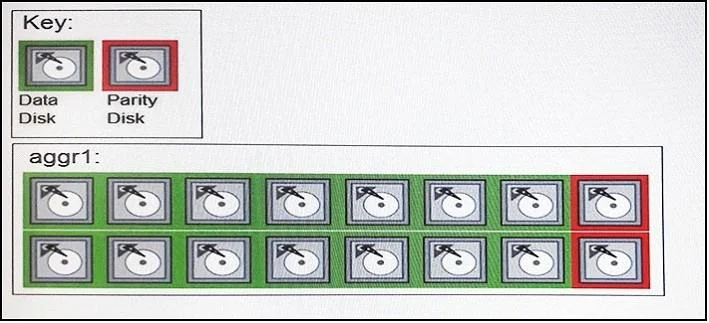
Click the Exhibit button. The maximum RAID group size of the RAID-DP aggr1 shown in the exhibit is 18. You expand the aggregate by 20 disks. How many of the new disks are used for data?
The correct answer is D. 18. When expanding a RAID-DP aggregate by 20 disks, 18 disks are utilized for data, while the remaining 2 are reserved for parity within a full RAID group.
Question
Click the Exhibit button. The maximum RAID group size of the RAID-DP aggr1 shown in the exhibit is 18. You expand the aggregate by 20 disks. How many of the new disks are used for data?
Exhibit
Options
- A20
- B16
- C14
- D18
How the community answered
(56 responses)- A4% (2)
- B7% (4)
- C13% (7)
- D77% (43)
Why each option
When expanding a RAID-DP aggregate by 20 disks, 18 disks are utilized for data, while the remaining 2 are reserved for parity within a full RAID group.
All 20 disks cannot be used for data in a RAID-DP configuration, as at least two disks are always allocated for parity.
16 data disks would be the outcome if 'maximum RAID group size of 18' referred to the total number of disks (16 data + 2 parity), leaving 2 disks in a partial group or unused, which contradicts the correct answer's implication.
14 data disks would typically result from a total RAID group size of 16 disks (14 data + 2 parity), which is not the maximum size specified in the question.
In a RAID-DP configuration, if 18 is the maximum number of data disks allowed per RAID group, then adding 20 disks allows for the formation of one full RAID group consisting of 18 data disks and 2 parity disks.
Concept tested: NetApp ONTAP RAID-DP disk allocation and aggregate expansion logic.
Source: https://docs.netapp.com/us-en/ontap-9/storage/disks-aggregates/concept_how_storage_system_handles_additional_disks_when_you_add_them.html
Topics
Community Discussion
No community discussion yet for this question.