
N10-009 · Question #113
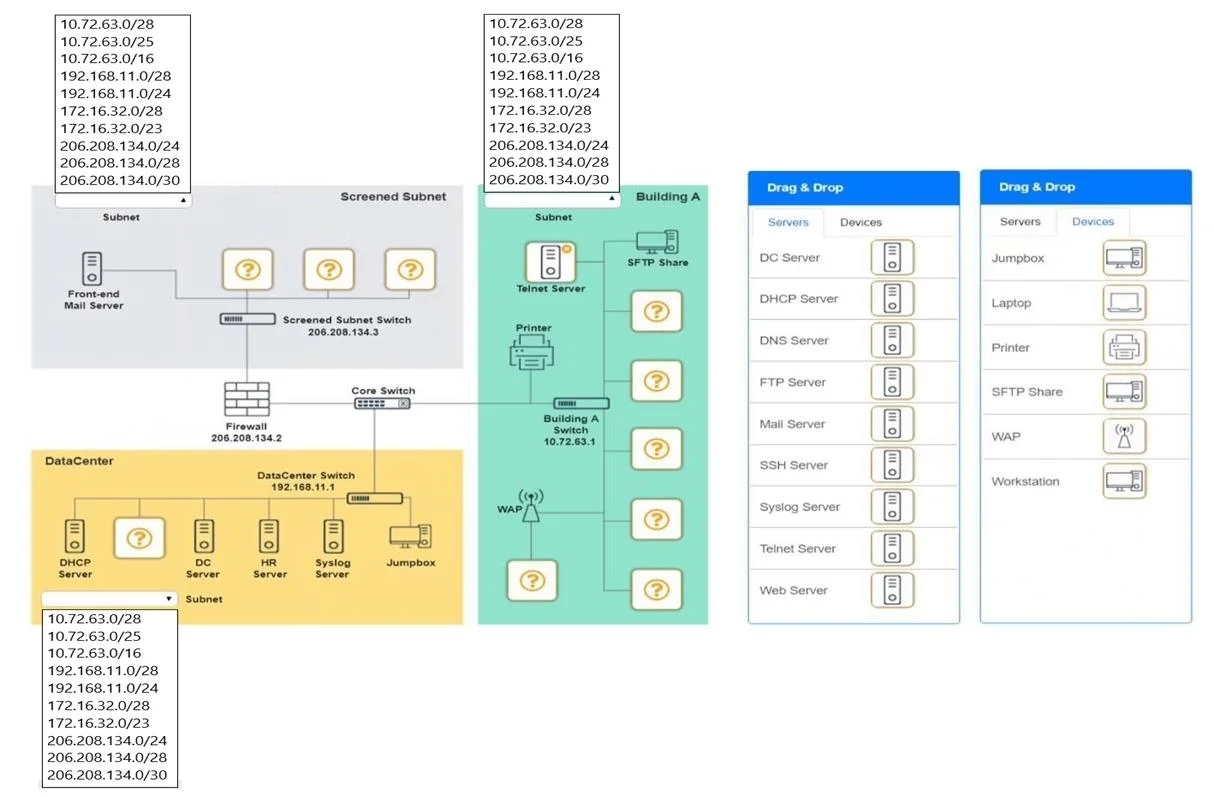
SIMULATION You are tasked with verifying the following requirements are met in order to ensure network security. Requirements: Datacenter - Ensure network is subnetted to allow all devices to…
This simulation tests your ability to design a segmented network by placing the correct server and device types in the appropriate network zones (Datacenter, Building A, Screened Subnet) while applying proper subnetting principles to minimize address waste.
Question
SIMULATION You are tasked with verifying the following requirements are met in order to ensure network security. Requirements:
Datacenter
- Ensure network is subnetted to allow all devices to communicate properly while minimizing
address space usage
- Provide a dedicated server to resolve IP addresses and hostnames correctly and handle
port 53 traffic Building A
- Ensure network is subnetted to allow all devices to communicate properly while minimizing
address space usage
- Provide devices to support 5 additional different office users
- Add an additional mobile user
- Replace the Telnet server with a more secure solution
Screened subnet
- Ensure network is subnetted to allow all devices to communicate properly while minimizing
address space usage
- Provide a server to handle external 80/443 traffic
- Provide a server to handle port 20/21 traffic
INSTRUCTIONS Drag and drop objects onto the appropriate locations. Objects can be used multiple times and not all placeholders need to be filled. Available objects are located in both the Servers and Devices tabs of the Drag & Drop menu. If at any time you would like to bring back the initial state of the simulation, please click the Reset All button. Answer:
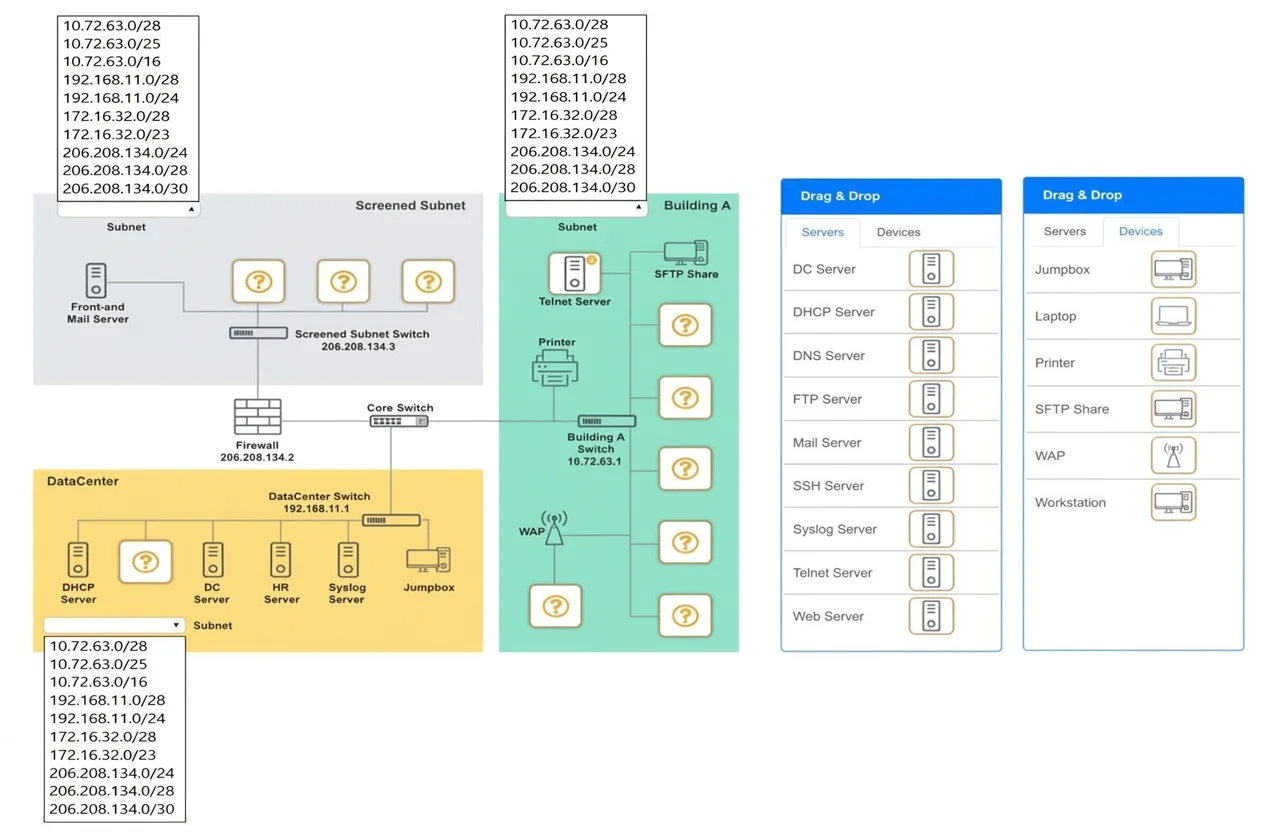
Screened Subnet devices - Web server, FTP server Building A devices - SSH server top left, workstations on all 5 on the right, laptop on bottom left DataCenter devices - DNS server.
Exhibits
Explanation
This simulation tests your ability to design a segmented network by placing the correct server and device types in the appropriate network zones (Datacenter, Building A, Screened Subnet) while applying proper subnetting principles to minimize address waste.
Approach. For the Datacenter, place a DNS server (handles port 53, resolves IP/hostnames) and subnet the network to fit only the required devices (e.g., /29 or /28). For Building A, add 5 workstations/PCs for office users, 1 mobile device (laptop/tablet), and replace the Telnet server with an SSH server (secure remote access alternative); subnet accordingly (e.g., /27 or /28 to support the required host count). For the Screened Subnet (DMZ), place a Web server (handles HTTP/HTTPS on ports 80/443) and an FTP server (handles ports 20/21 for file transfer); subnet to the minimum size needed for those servers (e.g., /29). The overarching principle is to use the smallest subnet that still accommodates all required hosts (minimize address space) while placing each server/device in the zone that matches its function and security role.
Concept tested. Network segmentation, subnetting (CIDR/VLSM to minimize address space), server role identification by port number (DNS=53, HTTP/HTTPS=80/443, FTP=20/21, SSH vs Telnet), and DMZ/screened subnet design principles as tested on CompTIA Network+ and Security+.
Reference. CompTIA Network+ Exam Objectives – Network Segmentation, Subnetting, and Common Ports; CompTIA Security+ – DMZ/Screened Subnet Architecture and Secure Protocol Replacement (SSH replacing Telnet)
Community Discussion
No community discussion yet for this question.