
MS-900 · Question #182
Hotspot Question You are the IT administrator for your company. You want to convince your manager to purchase a Microsoft 365 subscription. Your manager is concerned about security. You need to give…
The correct answer is An employee receives a text message on their personal cell phone when they log in to SharePoint Online. = Yes; An employee enters an email address and password to log in to Exchange Online. = No; An employee uses facial recognition to unlock their phone to access the mobile Word app. = Yes. Multi-factor authentication (MFA) requires the use of two or more different categories of authentication factors (something you know, have, or are) to verify identity.
Question
Exhibit
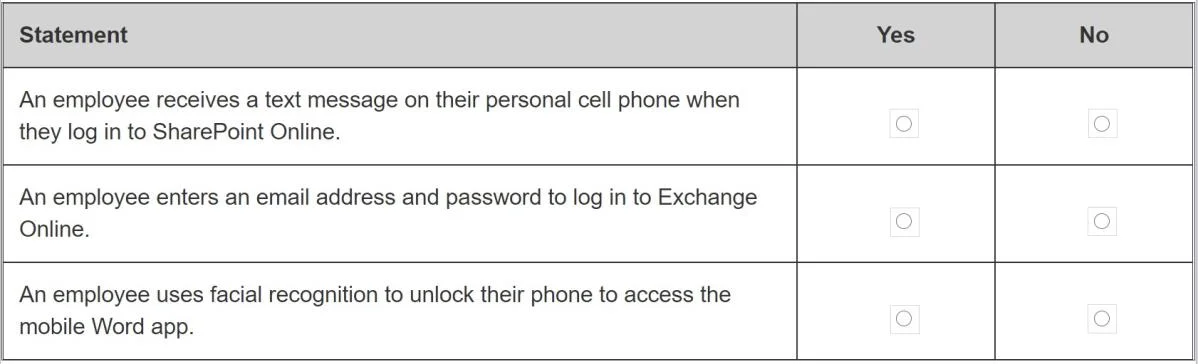
Answer Area
- An employee receives a text message on their personal cell phone when they log in to SharePoint Online.Yes
- An employee enters an email address and password to log in to Exchange Online.No
- An employee uses facial recognition to unlock their phone to access the mobile Word app.Yes
Explanation
Multi-factor authentication (MFA) requires the use of two or more different categories of authentication factors (something you know, have, or are) to verify identity.
Approach. 1. 'An employee receives a text message on their personal cell phone when they log in to SharePoint Online' -> Select Yes. Logging in implies using a primary credential (like a password, which is 'something you know'). Receiving a text message adds a secondary credential ('something you have' - the phone). This combination is MFA.
-
'An employee enters an email address and password to log in to Exchange Online' -> Select No. A password is only one factor ('something you know'). This is single-factor authentication.
-
'An employee uses facial recognition to unlock their phone to access the mobile Word app' -> Select No. Facial recognition is a single biometric factor ('something you are'). While it is used on a device you possess, the act of unlocking the phone with your face relies on only one authentication factor at that moment, replacing a PIN. It does not combine multiple independent factors for that specific authentication event.
Common mistakes.
- common_mistake. A common mistake is assuming that modern or advanced security methods, such as biometrics (facial recognition), inherently constitute MFA. However, MFA strictly requires the combination of at least two distinct factor types. Using only facial recognition, without also requiring a password or another physical token, is still single-factor authentication.
Concept tested. Multi-Factor Authentication (MFA) principles and identifying authentication factor types (knowledge, possession, inherence).
Reference. https://learn.microsoft.com/en-us/entra/identity/authentication/concept-mfa-howitworks
Topics
Community Discussion
No community discussion yet for this question.