
MS-900 · Question #151
Hotspot Question For each of the following statements, select Yes if the statement is true. Otherwise, select No. NOTE: Each correct selection is worth one point. Answer:
The correct approach is to select 'Yes' for the first two statements as they accurately describe benefits and characteristics of cloud applications, and 'No' for the third statement as cloud services are fundamentally dependent on internet connectivity.
Question
Exhibit
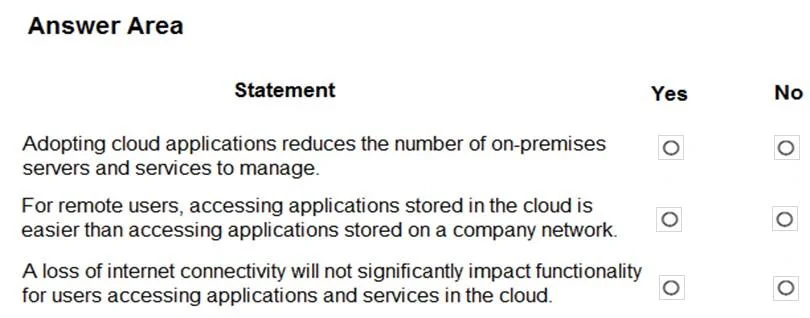
Answer Area
- Adopting cloud applications reduces the number of on-premises servers and services to manage.
- For remote users, accessing applications stored in the cloud is easier than accessing applications stored on a company network.
- A loss of internet connectivity will not significantly impact functionality for users accessing applications and services in the cloud.
Explanation
The correct approach is to select 'Yes' for the first two statements as they accurately describe benefits and characteristics of cloud applications, and 'No' for the third statement as cloud services are fundamentally dependent on internet connectivity.
Approach. The correct interaction involves selecting the following options:
-
Statement 1: 'Adopting cloud applications reduces the number of on-premises servers and services to manage.'
- Selection: 'Yes'
- Reasoning: One of the primary benefits of cloud computing is the offloading of infrastructure management to the cloud provider. When applications are migrated to the cloud (IaaS, PaaS, SaaS), organizations no longer need to purchase, maintain, patch, power, or cool physical servers in their own data centers, significantly reducing their on-premises server and service management burden.
-
Statement 2: 'For remote users, accessing applications stored in the cloud is easier than accessing applications stored on a company network.'
- Selection: 'Yes'
- Reasoning: Cloud applications are inherently designed for global internet accessibility, often requiring only a web browser or a dedicated client application. Accessing on-premises applications typically necessitates more complex setups for remote users, such as Virtual Private Networks (VPNs), specific firewall rules, or remote desktop solutions, which can be less straightforward and require more configuration and management than simply accessing a cloud-based service over the internet.
-
Statement 3: 'A loss of internet connectivity will not significantly impact functionality for users accessing applications and services in the cloud.'
- Selection: 'No'
- Reasoning: Cloud applications and services are hosted remotely and delivered over the internet. Without internet connectivity, users cannot establish a connection to these remote services, meaning their functionality will be entirely halted or severely impacted. This statement incorrectly suggests a lack of dependency.
Common mistakes.
- common_mistake. Selecting 'No' for the first statement would be incorrect because adopting cloud applications directly shifts the responsibility of managing underlying infrastructure (servers, storage, networking) and often the application itself to the cloud provider, thereby reducing the on-premises management overhead. Selecting 'No' for the second statement is incorrect because cloud services are typically designed for ease of remote access over the public internet, often simplifying the experience compared to securely accessing resources within a private corporate network. Selecting 'Yes' for the third statement would be fundamentally incorrect as cloud services, by definition, require an active internet connection to be accessible and functional. Any disruption to internet connectivity will directly prevent users from accessing cloud-based applications and data.
Concept tested. This question tests fundamental concepts of cloud computing, including its benefits (reduced on-premises management), accessibility characteristics (ease of remote access), and core dependencies (reliance on internet connectivity). It assesses an understanding of how cloud adoption impacts IT operations and user experience.
Topics
Community Discussion
No community discussion yet for this question.