
MS-721 · Question #129
Drag and Drop Question You have a Microsoft Teams Phone deployment. You need to create two call queues named CQ1 and CQ2. The solution must meet the following requirements: - CQ1 must balance…
The correct answer is Round robin; Attendant routing. This question tests knowledge of Microsoft Teams Phone call queue routing methods, requiring identification of the correct method for distributing calls evenly and for ringing all agents simultaneously.
Question
Exhibit
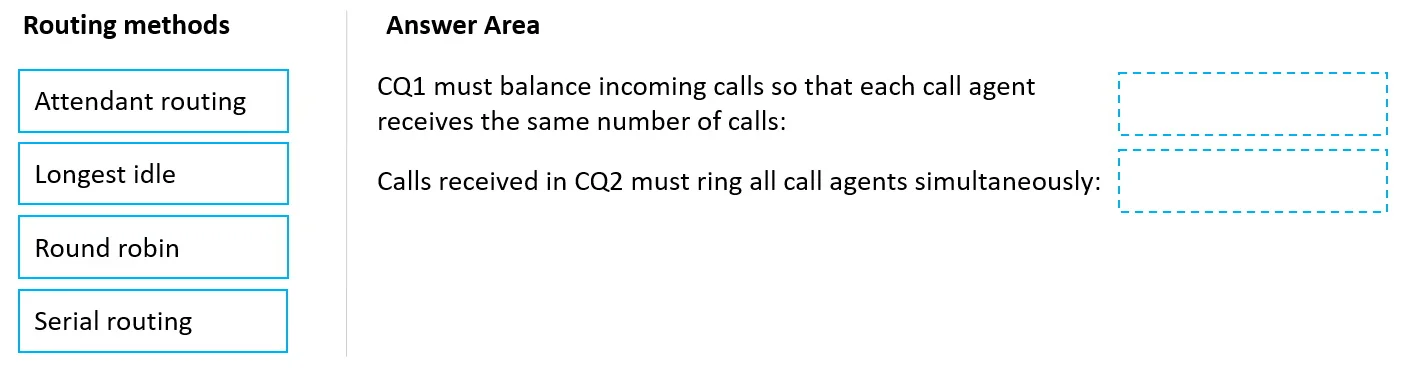
Answer Area
Drag items
Correct arrangement
- Round robin
- Attendant routing
Explanation
This question tests knowledge of Microsoft Teams Phone call queue routing methods, requiring identification of the correct method for distributing calls evenly and for ringing all agents simultaneously.
Approach. To answer correctly, drag 'Round robin' to the requirement for CQ1 and 'Attendant routing' to the requirement for CQ2.
-
For CQ1: 'CQ1 must balance incoming calls so that each call agent receives the same number of calls.'
- 'Round robin' routing distributes calls sequentially to agents in a pre-defined order, cycling back to the beginning after the last agent. This method inherently aims to provide an even distribution of calls over time, ensuring that each available agent receives a roughly equivalent number of calls, thereby fulfilling the requirement to 'balance incoming calls so that each call agent receives the same number of calls'.
-
For CQ2: 'Calls received by CQ2 must ring all call agents simultaneously.'
- 'Attendant routing' (also known as 'All at once' or 'Simultaneous' routing in some contexts) is the specific method in Microsoft Teams Call Queues that rings all agents in the queue at the same time. The first agent to answer the call receives it. This directly matches the requirement for calls to 'ring all call agents simultaneously'.
Common mistakes.
- common_mistake. 1. Choosing 'Longest idle' for CQ1: While 'Longest idle' also aims to balance call distribution, it does so by routing calls to the agent who has been available (idle) for the longest period. This is excellent for balancing workload by prioritizing the least busy agent, but 'Round robin' more directly addresses the goal of ensuring 'each call agent receives the same number of calls' through a systematic rotation, making it a more precise fit for the exact wording of the requirement.
- Choosing 'Serial routing' for either requirement: 'Serial routing' alerts agents one by one in a fixed order until the call is answered. It does not balance calls evenly across all agents (as the first agents in the list will typically receive more calls) nor does it ring all agents simultaneously. Therefore, it's incorrect for both requirements.
- Confusing 'Attendant routing' with other methods or its literal meaning: The name 'Attendant routing' can be misleading as it doesn't necessarily imply a human attendant is doing the routing. In the context of Teams Call Queues, it specifically means simultaneous ringing. Misinterpreting this can lead to incorrect selection for the simultaneous ring requirement.
Concept tested. Microsoft Teams Phone Call Queue routing methods, specifically understanding the functionality of Round robin, Longest idle, Serial routing, and Attendant routing for distributing incoming calls to agents.
Reference. https://learn.microsoft.com/en-us/microsoftteams/create-a-call-queue
Topics
Community Discussion
No community discussion yet for this question.