
MLS-C01 · Question #116
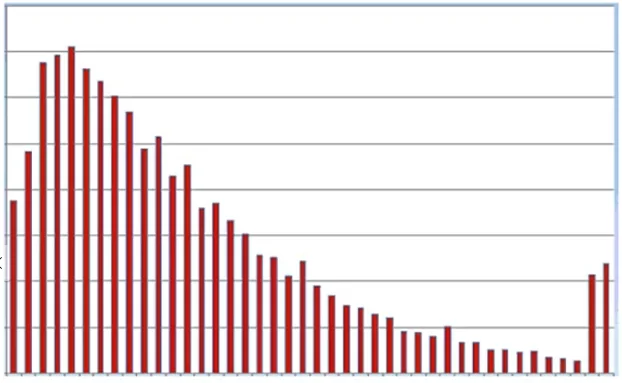
A Data Scientist is building a linear regression model and will use resulting p-values to evaluate the statistical significance of each coefficient. Upon inspection of the dataset, the Data…
The correct answer is B. Logarithmic transformation. Linear regression assumes that residuals (errors) are normally distributed. When a feature exhibits a right-skewed distribution (a long tail to the right, as depicted in the graphic), the raw values violate this normality assumption. A logarithmic transformation compresses…
Question
A Data Scientist is building a linear regression model and will use resulting p-values to evaluate the statistical significance of each coefficient. Upon inspection of the dataset, the Data Scientist discovers that most of the features are normally distributed. The plot of one feature in the dataset is shown in the graphic. What transformation should the Data Scientist apply to satisfy the statistical assumptions of the linear regression model?
Exhibit
Options
- AExponential transformation
- BLogarithmic transformation
- CPolynomial transformation
- DSinusoidal transformation
How the community answered
(13 responses)- A8% (1)
- B85% (11)
- C8% (1)
Explanation
Linear regression assumes that residuals (errors) are normally distributed. When a feature exhibits a right-skewed distribution (a long tail to the right, as depicted in the graphic), the raw values violate this normality assumption. A logarithmic transformation compresses large values and expands small values, effectively pulling in the right tail and making the distribution more symmetric and closer to normal. This is the standard technique for right-skewed data. An exponential transformation (A) would make skewness worse. Polynomial transformation (C) is used to capture non-linear relationships, not to fix skewness. Sinusoidal transformation (D) is inappropriate for this scenario. The logarithmic transformation (B) is the correct and most commonly recommended remedy for right-skewed features prior to linear regression.
Topics
Community Discussion
No community discussion yet for this question.