
MLS-C01 · Question #105
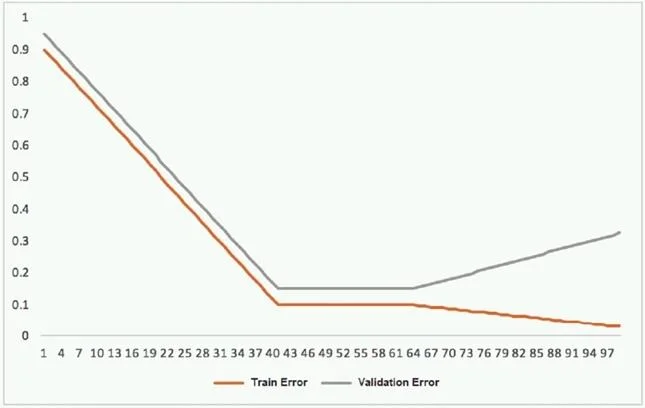
This graph shows the training and validation loss against the epochs for a neural network. The network being trained is as follows: Two dense layers, one output neuron 100 neurons in each layer 100…
The correct answer is A. Early stopping. The described scenario - training loss continues to decrease while validation loss diverges or plateaus - is the textbook signature of overfitting. Early stopping monitors the validation loss during training and halts the process when validation performance stops improving (or…
Question
This graph shows the training and validation loss against the epochs for a neural network. The network being trained is as follows:
Two dense layers, one output neuron 100 neurons in each layer 100 epochs Random initialization of weights Which technique can be used to improve model performance in terms of accuracy in the validation set?
Exhibit
Options
- AEarly stopping
- BRandom initialization of weights with appropriate seed
- CIncreasing the number of epochs
- DAdding another layer with the 100 neurons
How the community answered
(15 responses)- A93% (14)
- C7% (1)
Explanation
The described scenario - training loss continues to decrease while validation loss diverges or plateaus - is the textbook signature of overfitting. Early stopping monitors the validation loss during training and halts the process when validation performance stops improving (or begins to degrade), saving the model weights from the epoch with the best validation performance. This prevents the model from over-fitting the training data in later epochs. The other options are incorrect: increasing epochs (C) prolongs the overfitting phase; adding another 100-neuron layer (D) increases model capacity and worsens overfitting; changing the random seed for weight initialization (B) does not address the fundamental overfitting problem and only affects the starting point of optimization.
Topics
Community Discussion
No community discussion yet for this question.