
MCD-LEVEL-1 · Question #101
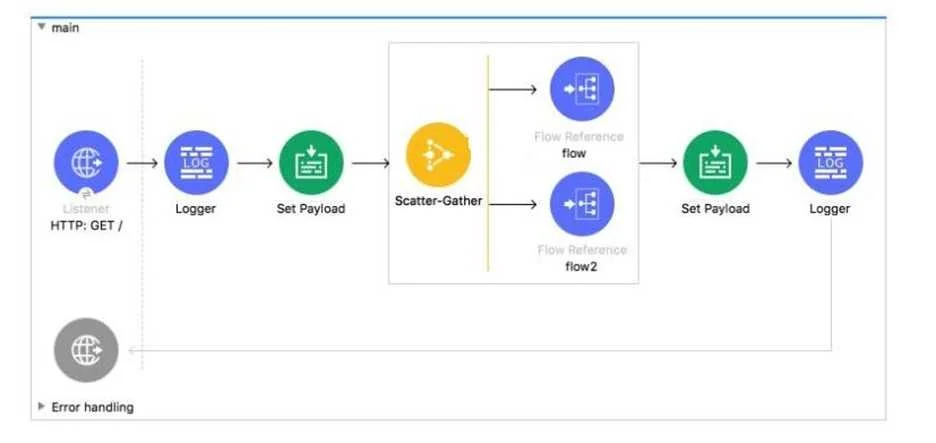
Refer to exhibits. In the execution of the Scatter-Gather , the flow route completes after 10 seconds and the flow2 route completes in 40 seconds. How many seconds does it take for the…
The correct answer is C. 40. Scatter-Gather sends the event to each routes concurrently. Hence both route in this example will start in parallel. So total time to complete processing is 40 seconds The Scatter-Gather component is a routing event processor that processes a Mule event through different…
Question
Refer to exhibits. In the execution of the Scatter-Gather , the flow route completes after 10 seconds and the flow2 route completes in 40 seconds. How many seconds does it take for the Scatter-Gather to complete?
Exhibit
Options
- A10
- B50
- C40
- D20
How the community answered
(53 responses)- A2% (1)
- B6% (3)
- C91% (48)
- D2% (1)
Explanation
Scatter-Gather sends the event to each routes concurrently. Hence both route in this example will start in parallel. So total time to complete processing is 40 seconds The Scatter-Gather component is a routing event processor that processes a Mule event through different parallel processing routes that contain different event processors. Each route receives a routes uses a separate thread to execute the event processors, and the resulting Mule event can be either the same Mule event without modifications or a new Mule event with its own payload, attributes, and variables. The Scatter-Gather component then combines the Mule events returned by each processing route into a new Mule event that is passed to the next event processor only after every route completes successfully. The Scatter-Gather component executes each route in parallel, not sequentially. Parallel execution of routes can greatly increase the efficiency of your Mule application and may provide more information than sequential processing. Mule Ref Doc : https://docs.mulesoft.com/mule-runtime/4.3/scatter-gather-concept
Topics
Community Discussion
No community discussion yet for this question.