MB-800 · Question #177
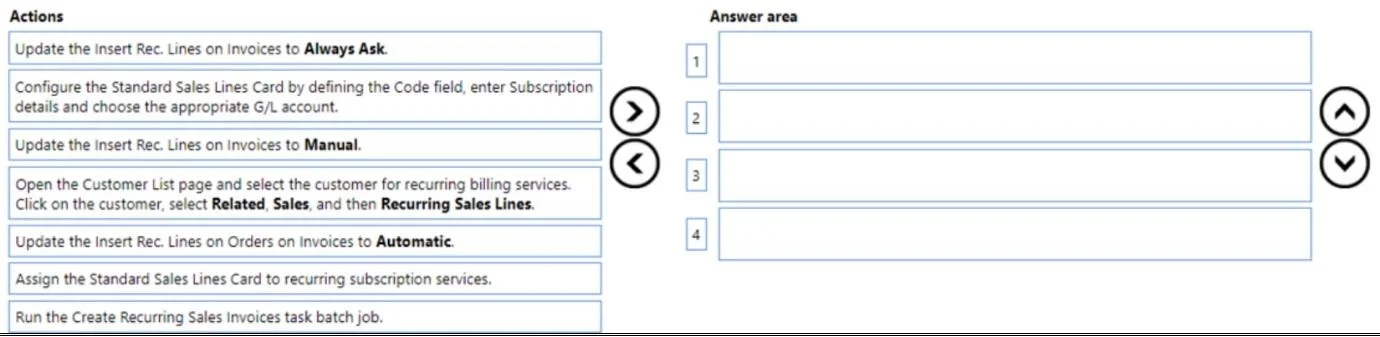
Drag and Drop Question A company uses Dynamics 365 Business Central. The company bills thousands of sales invoices for recurring subscription services on a monthly basis. You need to ensure…
The correct answer is Open the Customer List page and select the customer for recurring billing services. Then, on the Customer Card page, open the Rec. Sales Line.; Assign the Standard Sales Lines Card to recurring subscription services.; Update the inert Rec. Lines on orders on invoices to Automatic.; Run the Create Recurring Sales Invoices task batch job. Dynamics 365 Business Central - Recurring Sales Invoices Setup Overview of the Process Recurring invoices in Business Central rely on Standard Sales Lines (pre-defined line templates) assigned to customers, with an automation setting that lets a batch job generate invoices…
Question
Exhibit
Answer Area
Drag items
Correct arrangement
- Open the Customer List page and select the customer for recurring billing services. Then, on the Customer Card page, open the Rec. Sales Line.
- Assign the Standard Sales Lines Card to recurring subscription services.
- Update the inert Rec. Lines on orders on invoices to Automatic.
- Run the Create Recurring Sales Invoices task batch job.
Explanation
Dynamics 365 Business Central - Recurring Sales Invoices Setup
Overview of the Process
Recurring invoices in Business Central rely on Standard Sales Lines (pre-defined line templates) assigned to customers, with an automation setting that lets a batch job generate invoices without manual intervention. The four steps follow a strict dependency chain: you must exist in the right place before you can configure it, configure before you can automate, and automate before you can run the job.
Step-by-Step Breakdown
Step 1: Open the Customer List → select the customer → open Rec. Sales Line
This must come first because everything else is customer-specific configuration. You cannot assign recurring lines or set automation behavior without first navigating to the correct Customer Card. The Rec. Sales Lines subpage is only accessible from within the Customer Card - it's the anchor point for all subsequent steps.
Misconception: Some candidates think you start by creating or configuring the Standard Sales Lines Card. That's a prerequisite that's assumed to exist already (or done separately). The question's scope is the automation setup for a specific customer, not the initial template creation.
Step 2: Assign the Standard Sales Lines Card to recurring subscription services
Once you're on the customer's Rec. Sales Lines page (opened in Step 1), you assign the pre-existing Standard Sales Lines code to that customer. This links the subscription line items (G/L account, quantity, description) to the customer record so the batch job knows what to invoice.
Misconception: "Configure the Standard Sales Lines Card" (the distractor) looks like it belongs here or before Step 1. It is excluded because it's a prior setup task, not part of the per-customer automation sequence. Mixing it in breaks the logical flow.
Step 3: Update the Rec. Lines insertion setting to Automatic
With the Standard Sales Lines assigned, you now set how they are applied. The Automatic option tells Business Central to insert the recurring lines without any user prompt when the batch job runs. The other two options are wrong for this scenario:
| Option | Behavior | Why wrong here |
|---|---|---|
| Manual | User must trigger insertion themselves | Defeats the automation goal |
| Always Ask | Prompts the user each time | Requires human interaction; not scalable for thousands of invoices |
Automatic is the only option that supports unattended, mass creation of invoices.
Misconception: Candidates sometimes confuse "Automatic" with "Always Ask" thinking a confirmation step adds safety. For batch processing thousands of invoices, prompting defeats the entire purpose.
Step 4: Run the Create Recurring Sales Invoices batch job
This is the execution step. Only after the customer is configured (Steps 1–3) can the batch job do its work - it scans customers flagged with Automatic, reads their assigned Standard Sales Lines, and generates the invoices. Running this before Steps 1–3 would produce nothing for this customer.
Misconception: Some candidates think this step could come earlier or be optional. It is the only mechanism that actually creates the invoices - without running the batch job, no invoices are generated regardless of how the customer is configured.
Why the Excluded Options Are Wrong
| Distractor | Why excluded |
|---|---|
| Configure the Standard Sales Lines Card | A prerequisite, not part of the per-customer automation sequence |
| Update Rec. Lines to Manual | Opposite of automation |
| Update Rec. Lines to Always Ask | Requires user interaction; incompatible with batch processing |
Key Takeaway
The sequence follows a strict navigate → assign → configure → execute pattern. Each step unlocks the next: you can't assign without navigating, can't set Automatic without assigning, and the batch job is meaningless without the preceding configuration.
Topics
Community Discussion
No community discussion yet for this question.