
MB-700 · Question #37
Drag and Drop Question A winery is considering using Dynamics 365 Finance to implement a large-scale ERP application and needs to understand the differences between cloud-based and on-premises…
This question tests understanding of how Dynamics 365 Finance behaves differently under cloud-based (SaaS) versus on-premises deployment models, specifically around infrastructure ownership, source code access, update management, and upgrade-safe customization.
Question
Exhibit
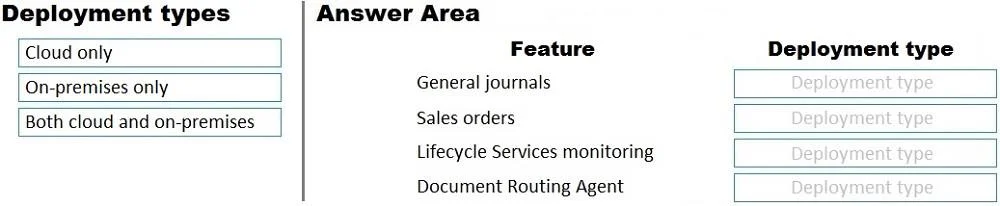
Explanation
This question tests understanding of how Dynamics 365 Finance behaves differently under cloud-based (SaaS) versus on-premises deployment models, specifically around infrastructure ownership, source code access, update management, and upgrade-safe customization.
Approach. On-premises deployments give the customer full control - including direct source code modification (overlayering) and self-managed updates - but that control comes at the cost of upgrade complexity, since code changes can break during version upgrades. Cloud-based (SaaS) deployments shift infrastructure and update management to Microsoft, and they enforce an extension-only customization model (no overlayering), which means customizations survive upgrade cycles cleanly. 'Provides hardware infrastructure management' maps to Cloud-based because Microsoft owns and operates the servers. 'Supports customization without affecting the upgrade cycle' also maps to Cloud-based because the extension model decouples customer code from the core application. 'Allows companies to modify source code' and 'Requires customer to manage their own updates' both map to On-premises because those responsibilities rest entirely with the customer in that model.
Concept tested. Dynamics 365 Finance deployment model differences: cloud-based (Microsoft-managed infrastructure, extension-based customization, automatic updates) vs. on-premises (customer-managed infrastructure and updates, source code modification via overlayering, upgrade-cycle risk).
Reference. Microsoft Learn - 'Cloud vs. on-premises deployments' in Dynamics 365 Finance documentation; MB-300 and MB-310 exam objective: 'Describe deployment options for Finance and Operations apps.'
Topics
Community Discussion
No community discussion yet for this question.