
MB-500 · Question #358
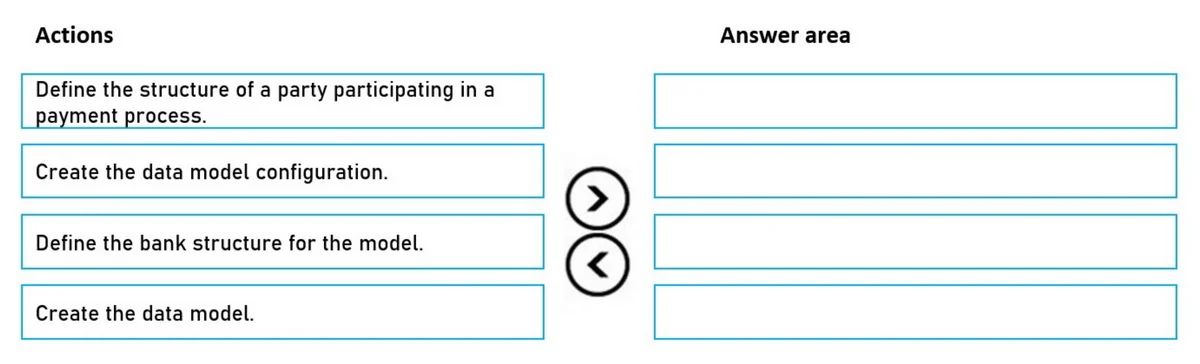
Drag and Drop Question A company uses Dynamics 365 Finance. The company plans to send banking information by using Electronic reporting (ER). You need to create an ER data model. In which order…
The correct answer is Create the data model.; Define the structure of a party participating in a payment process.; Define the bank structure for the model.; Create the data model configuration. ER Data Model Creation Order - Explained The Correct Sequence --- Step 1: Create the data model This must come first because the data model is the container artifact. Everything else - structures, definitions, mappings - lives inside it. You cannot define anything within an…
Question
Exhibit
Answer Area
Drag items
Correct arrangement
- Create the data model.
- Define the structure of a party participating in a payment process.
- Define the bank structure for the model.
- Create the data model configuration.
Explanation
ER Data Model Creation Order - Explained
The Correct Sequence
Step 1: Create the data model
This must come first because the data model is the container artifact. Everything else - structures, definitions, mappings - lives inside it. You cannot define anything within an object that doesn't yet exist. In ER, you create the data model node in the configuration tree before populating it with any structural elements.
Common mistake: Confusing this step with Step 4. "Create the data model" initializes the design artifact; "Create the data model configuration" finalizes and packages it. These are distinct operations at opposite ends of the workflow.
Step 2: Define the structure of a party participating in a payment process
Parties are the foundational entities in any payment - payers, payees, and intermediaries. Banks are a specific kind of party, so the generic party structure must exist before you can layer bank-specific attributes on top of it. This establishes shared fields like name, address, and identifier that both parties and banks reuse.
Common mistake: Jumping straight to bank structure. Banks participate as parties in transactions, so defining party structure first avoids redundancy and establishes the correct inheritance/reference chain.
Step 3: Define the bank structure for the model
With the party structure in place, you now define bank-specific attributes (SWIFT/BIC codes, routing numbers, account details). This step extends or references the party structure rather than duplicating it. It depends on Step 2 being complete.
Common mistake: Treating bank structure and party structure as independent. Bank structure in ER payment models typically builds on party definitions - the ordering reflects that dependency.
Step 4: Create the data model configuration
This is the packaging/publishing step. Once the data model is fully designed with all its structures, you create the configuration that makes it usable - activating it for mapping, format assignment, and deployment. A configuration created before the model is complete would be incomplete and unusable.
Common mistake: Treating configuration creation as a setup step rather than a completion step. It finalizes the artifact, it doesn't initiate it.
Why the Note Says "More Than One Order Is Correct"
Steps 2 and 3 can be swapped in some interpretations - defining bank structure before party structure is technically possible if they are treated as independent nodes. However, the canonical answer has party first because the party entity is more abstract and foundational. The firm constraints are: Step 1 must be first and Step 4 must be last.
Topics
Community Discussion
No community discussion yet for this question.