
MB-500 · Question #142
Drag and Drop Question A company implements Dynamics 365 Finance and Dynamics 365 Supply Chain Management. Customers place orders from the company website store or through sales representatives. You…
The correct answer is Dual-write; Virtual entity; Composite entity. Explanation: Dynamics 365 Integration Strategy The question maps 3 app features to the correct integration technology. Here's the breakdown: --- The Three Features and Why | # | App Feature / Requirement | Answer | |---|---|---| | 1 | Create new customers | Dual-write | | 2 |…
Question
Exhibit
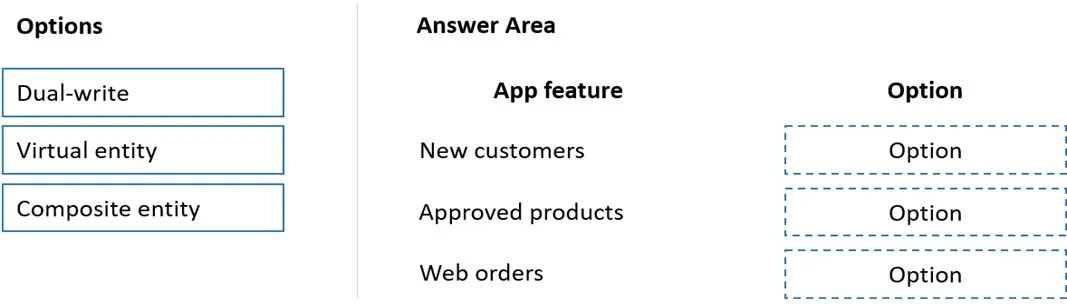
Answer Area
Drag items
Correct arrangement
- Dual-write
- Virtual entity
- Composite entity
Explanation
Explanation: Dynamics 365 Integration Strategy
The question maps 3 app features to the correct integration technology. Here's the breakdown:
The Three Features and Why
| # | App Feature / Requirement | Answer |
|---|---|---|
| 1 | Create new customers | Dual-write |
| 2 | Only approved products can be sold | Virtual entity |
| 3 | Web sales imported nightly | Composite entity |
Item-by-Item Reasoning
1. Dual-write → Create new customers
Dual-write provides near real-time, bidirectional synchronization between Dataverse (Power Platform) and D365 Finance/SCM. When a sales rep creates a customer in the Power Platform app, dual-write immediately propagates that record into D365 Finance - no manual sync required. This is the only option that enables live write-back to D365 from an external app.
2. Virtual entity → Only approved products can be sold
Virtual entities surface D365 data inside Dataverse without copying it. The product catalog lives in D365 SCM, and the Power Platform app reads it live via virtual tables. This guarantees that only products that are currently approved in D365 appear in the app - there's no risk of a stale local copy allowing unapproved products to be sold.
3. Composite entity → Nightly web sales import
Composite entities are part of D365's Data Management Framework (DMF) and are designed for bulk import/export of structured data. Web sales collected overnight are packaged and imported into D365 as a batch - exactly the use case DMF composite entities are built for.
The offline availability requirement is addressed by Power Apps' built-in mobile offline profile capability for canvas/model-driven apps, not by these integration technologies - which is why it doesn't appear as a drag target.
Common Mistakes
- Confusing dual-write with virtual entities: Dual-write copies and syncs data bidirectionally. Virtual entities don't copy - they query live. For creating records, you need dual-write, not virtual entities.
- Using composite entity for customer sync: Composite entities are batch-oriented (DMF). They're wrong for real-time customer creation.
- Thinking virtual entities work offline: They don't - virtual entities make live API calls to D365, so they require internet connectivity. This is why they're used for the product catalog lookup (online use), not offline scenarios.
Topics
Community Discussion
No community discussion yet for this question.