
MB-310 · Question #192
Drag and Drop Question You are implementing Dynamics 365 Finance. You must associate items with an item model group. An inventory close must not be required. You need to configure the item model…
The correct answer is Standard cost; Moving average. Dynamics 365 Finance: Costing Methods Without Inventory Close The Core Requirement The constraint is: inventory close must NOT be required. In D365 Finance, inventory close is a period-end process that settles open transactions and recalculates costs to their final values. Some…
Question
Exhibit
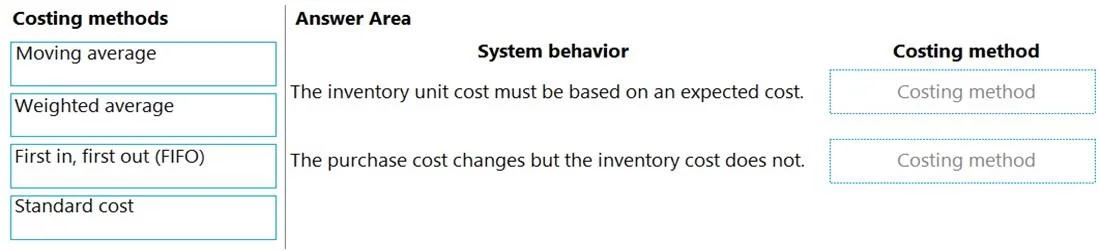
Answer Area
Drag items
Correct arrangement
- Standard cost
- Moving average
Explanation
Dynamics 365 Finance: Costing Methods Without Inventory Close
The Core Requirement
The constraint is: inventory close must NOT be required. In D365 Finance, inventory close is a period-end process that settles open transactions and recalculates costs to their final values. Some costing methods depend on this process; others calculate costs perpetually without it.
Why Each Answer is Correct
1. Standard Cost
- Costs are predefined (set by the user before transactions occur).
- Every receipt and issue posts at the predetermined standard cost immediately.
- Variances between actual purchase price and standard cost are posted to variance accounts automatically at the time of the transaction.
- There is nothing to settle at period-end - the cost is already fixed.
- No inventory close required.
2. Moving Average
- Cost is recalculated perpetually every time a new receipt is posted, using the formula: (existing inventory value + new receipt value) / total quantity.
- Issues are costed at the current moving average at the moment of the transaction.
- Because the cost updates continuously in real time, there is no need for a period-end settlement run.
- No inventory close required.
Why the Other Options Are Wrong
FIFO (First In, First Out)
- Issues are posted at an interim cost during the period.
- Inventory close is required to match issues to the oldest open receipts (cost layers) and post the financial adjustment. Without close, FIFO adjustments never happen.
Weighted Average
- The true weighted average cost can only be calculated after the period ends, once all receipts are known.
- Inventory close is required to calculate the period's average cost and settle open transactions against it.
Common Misconceptions
| Misconception | Reality |
|---|---|
| "Weighted average sounds like a running calculation" | It's a period-end average, not a running one. Moving average is the running one. |
| "Standard cost is complex, so it must need close" | Standard cost is the simplest at period-end - variances are already posted; nothing to settle. |
| "FIFO is straightforward, so it doesn't need close" | FIFO requires close precisely because it must match specific cost layers, which requires a settlement step. |
Key mental model: If the costing method determines cost at the moment of transaction (Standard, Moving Average), no close is needed. If it determines cost based on what happened across the whole period (FIFO layers, Weighted Average pooling), close is required.
Topics
Community Discussion
No community discussion yet for this question.