
MB-310 · Question #159
Drag and Drop Question A customer implements Dynamics 365 Finance. The customer observes that during foreign currency revaluation of the Accounts Receivable subledger, the results are not as…
The correct answer is Standard; Minimum; Invoice date. Dynamics 365 Finance - Foreign Currency Revaluation Methods Important note: The requirements (left side) are missing from the transcription - only the answer items are shown. However, the standard exam format for this question maps to these three well-known requirements. Here's…
Question
Exhibit
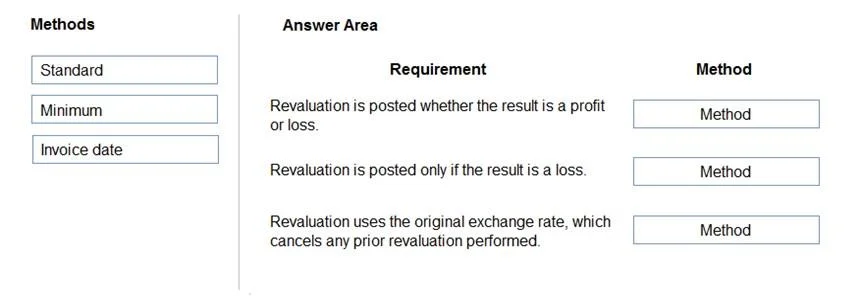
Answer Area
Drag items
Correct arrangement
- Standard
- Minimum
- Invoice date
Explanation
Dynamics 365 Finance - Foreign Currency Revaluation Methods
Important note: The requirements (left side) are missing from the transcription - only the answer items are shown. However, the standard exam format for this question maps to these three well-known requirements. Here's the explanation based on the canonical version of this question.
The Three Methods Explained
1. Standard → Requirement: Revalue all open transactions at the current exchange rate
The Standard method revalues every open foreign currency transaction using the exchange rate on the revaluation run date. It posts unrealized gain/loss journal entries for all open transactions regardless of direction (gain or loss).
- Why it fits: This is the full mark-to-market approach. The customer wants a complete picture of currency exposure on the revaluation date.
- Common mistake: Confusing "Standard" with "default/do-nothing." It still actively posts journal entries - it just doesn't filter by gain/loss direction.
2. Minimum → Requirement: Revalue only transactions that result in a loss
The Minimum method applies the accounting principle of conservatism. It only revalues a transaction if the result is an unrealized loss (or increases an existing loss). It will not post unrealized gains.
- Why it fits: The customer wants to recognize downside risk but not book gains that haven't been realized yet.
- Common mistake: Assuming "Minimum" means a minimum threshold amount. It actually means "at minimum, recognize losses" - it is about direction, not magnitude.
3. Invoice date → Requirement: Revalue using the exchange rate from the original transaction date
The Invoice date method revalues the open transaction using the exchange rate from the original invoice date, not the current date. This effectively resets the transaction to its original rate, reversing any previously posted unrealized gain/loss.
- Why it fits: The customer needs to undo or neutralize prior revaluation results and bring transactions back to their original basis.
- Common mistake: Thinking this method calculates a new gain/loss. In practice, since it uses the rate already embedded in the transaction, it zeroes out the unrealized position rather than creating new exposure.
Quick Reference
| Requirement | Method | Key Behavior |
|---|---|---|
| Revalue all open transactions at today's rate | Standard | Full mark-to-market, both gains and losses |
| Revalue only loss-generating transactions | Minimum | Conservative; losses only |
| Revalue using original invoice rate | Invoice date | Reverses/resets prior revaluation |
Topics
Community Discussion
No community discussion yet for this question.