nerdexam
Microsoft

MB-310 · Question #109

Case Study 2 - Munson Background Munson's Pickles and Preserves Farm grows and distributes produce, jellies, and jams. The company's corporate headquarters is located in Dallas, TX. Munson's has one…

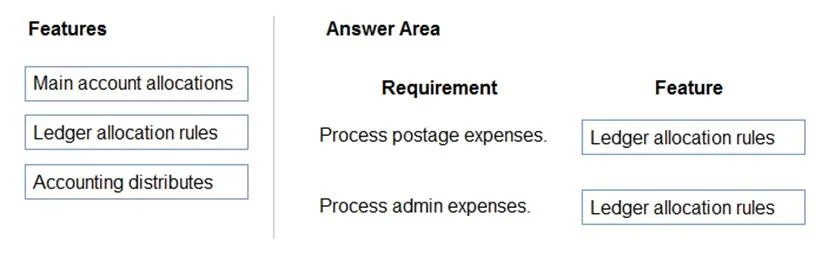
The correct answer is Ledger allocation rules; Ledger allocation rules. Dynamics 365 Finance - Expense Allocation Features The Two Requirements Being Mapped From the case study's Finance requirements: 1. Postage expenses must be split evenly across the regional distribution centers automatically. 2. Administrative expenses must be distributed…

Implement financial management

Question

Case Study 2 - Munson Background Munson's Pickles and Preserves Farm grows and distributes produce, jellies, and jams. The company's corporate headquarters is located in Dallas, TX. Munson's has one operations center and seven regional distribution centers in the United States. The company has two wholly owned subsidiaries that operate in Canada. The Canadian entity owns an entity in France. Munson's plans to expand into Latin America by purchasing the last 25 percent of a subsidiary that they own in Costa Rica. This process is expected to complete within the next two years. The company plans to implement Dynamics 365 Finance and Dynamics 365 Supply Chain to meet their growing business needs. Current environment. General Munson's uses a mix of internally-developed legacy systems that handle their finance and distribution activities. The company has an isolated CRM system. Both Canadian subsidiaries have two departments: marketing and operations. Financial reporting is difficult due to data residing in disparate systems. Financial reporting is currently performed by using Microsoft Excel. Pre-orders in the current system are difficult to track because the order management system is not integrated with the finance system. Pickle sales post to one revenue account, but this does not allow for targeted reporting by pickle cut and type. Current environment. Organization The following chart shows Accounting/Reporting Currencies and Tax ID, if applicable. Typically, vendor invoices are received prior to receipt of product. The following fixed assets are sold for a loss: 1. BUILD-100 2. CAR-1233 At the regional distribution centers, the value for physical inventory does not match the inventory in the financial system. Munson's rents their corporate office. Rent is not paid by purchase order. Rent is due once a quarter. Allocations are performed manually. Barrels are inventoried by site and warehouse. Munson's has multiple depreciation and tax books for all of their fixed asset equipment. Budgets are posted at the department level for each legal entity. Requirements. Sales Customers should be able to pre-order for fall release of pickles. Three-way matching must be enforced for all purchases. Fixed asset sale transactions require a ledger account entered at the time of transaction. Fixed assets purchased must be automatically created in fixed asset module. This includes inventory items and write in purchase orders/non-inventoried items. One dollar from every sale needs must be tracked and donated at the end of each month to a charitable organization. Purchasing budgets must be enforced at the main account level. Requirements. Finance Accounts payable must be able to enter vendor invoices on the day they were received to be settled against when product is received. Accounts payable must be able to enter vendor invoices to accrue expense without specifying a purchase order at the time of entry. Postage expenses must be split evenly across the regional distribution centers automatically. Administrative expenses must be distributed across the regional distribution centers by percentage of fulfillment orders monthly. Pickling machines depreciation must be uniquely recorded for visibility but not post to the ledger. Issues During implementation testing, User1 indicates that after packing slips are generated for purchase orders, there are no ledger postings. User2 indicates that fixed assets purchased on a purchase order do not show up in the Fixed Assets module. User3 reports that they are seeing inconsistent application of the one-dollar donation from all sales orders. User4 in the Canadian subsidiary is able to purchase supplies for marketing despite exceeding the marketing department budget. User5 reports that when purchasing a non-inventoried computer, the system is automatically assigning it to the buildings fixed asset group. Drag and Drop Question You need to process expense allocations. Which features should you use? To answer, drag the appropriate features to the correct requirements. Each feature may be used once, more than once, or net at all. You may need to drag the split bar between panes or scroll to view content. NOTE: Each correct selection is worth one point. Answer:

Exhibit

MB-310 question #109 exhibit

Answer Area

Drag items

Main account allocationsLedger allocation rulesAccounting distributes

Correct arrangement

  • Ledger allocation rules
  • Ledger allocation rules

Explanation

Dynamics 365 Finance - Expense Allocation Features

The Two Requirements Being Mapped

From the case study's Finance requirements:

  1. Postage expenses must be split evenly across the regional distribution centers automatically.
  2. Administrative expenses must be distributed across regional distribution centers by percentage of fulfillment orders monthly.

Both map to: Ledger allocation rules


Feature Definitions

FeatureWhat it does
Ledger allocation rulesA periodic batch process that redistributes posted ledger balances using either fixed percentages or a variable basis (another ledger balance). Ideal for automated, scheduled allocations.
Main account allocationsSplits a transaction at the time of posting using fixed percentages configured directly on the main account. Happens at entry, not in batch.
Accounting distributionsUsed on source documents (POs, invoices) to assign amounts to financial dimensions at the document level. Not a periodic allocation tool.

Why Each Placement is Ledger Allocation Rules

Requirement 1 - Postage split evenly (→ Ledger allocation rules)

Even though a fixed, even split sounds like a job for Main account allocations, Ledger allocation rules is correct because:

  • The split must happen automatically as a batch process, not at the time someone enters a postage invoice
  • The distribution is across seven separate regional distribution centers (financial dimensions), which fits the batch allocation model
  • Consistency: both allocations run on the same periodic schedule

Requirement 2 - Admin expenses by % of fulfillment orders monthly (→ Ledger allocation rules)

This must be Ledger allocation rules because:

  • The percentage is variable - it is derived from another ledger balance (fulfillment order activity), not a fixed number
  • Ledger allocation rules support an allocation basis: they look at source ledger amounts (e.g., fulfillment orders by center) to calculate each center's proportional share dynamically
  • The word monthly confirms a periodic/scheduled batch run, not an at-entry split

Common Mistakes

  • Choosing Main account allocations for Requirement 1: Tempting because it's an even split, but Main account allocations fire at posting time and are fixed - they can't be scheduled as a batch, and they don't fit the "automatic periodic redistribution" pattern described.
  • Choosing Accounting distributions: This is a document-level tool (used on invoices/POs to assign costs to dimensions). It is not an allocation engine and has no batch/scheduling capability.
  • Thinking the two requirements need different features: Both require the same tool - Ledger allocation rules - but configured differently (fixed % for postage, basis-driven % for admin).

Topics

#ledger allocation rules#expense allocation#cost distribution#postage expenses

Community Discussion

No community discussion yet for this question.

Full MB-310 Practice