
LEAD-AUDITOR · Question #337
Drag and Drop Question Auditors need to communicate effectively with auditees. Therefore, their personal behaviour is a key characteristic needed to ensure a successful audit. Below there are the…
The correct answer is Observant; Ethical; Open to improvement; Diplomatic; Perceptive. Auditor Personal Characteristics - Drag & Drop Explained This question is based on ISO 19011:2018 (Guidelines for Auditing Management Systems), Section 7.2.2, which defines personal attributes auditors must possess. --- The Correct Arrangement and Why The descriptions in the…
Question
Drag and Drop Question Auditors need to communicate effectively with auditees. Therefore, their personal behaviour is a key characteristic needed to ensure a successful audit. Below there are the characteristics and a brief related description. Match the characteristics to the descriptions. Answer:
Exhibit
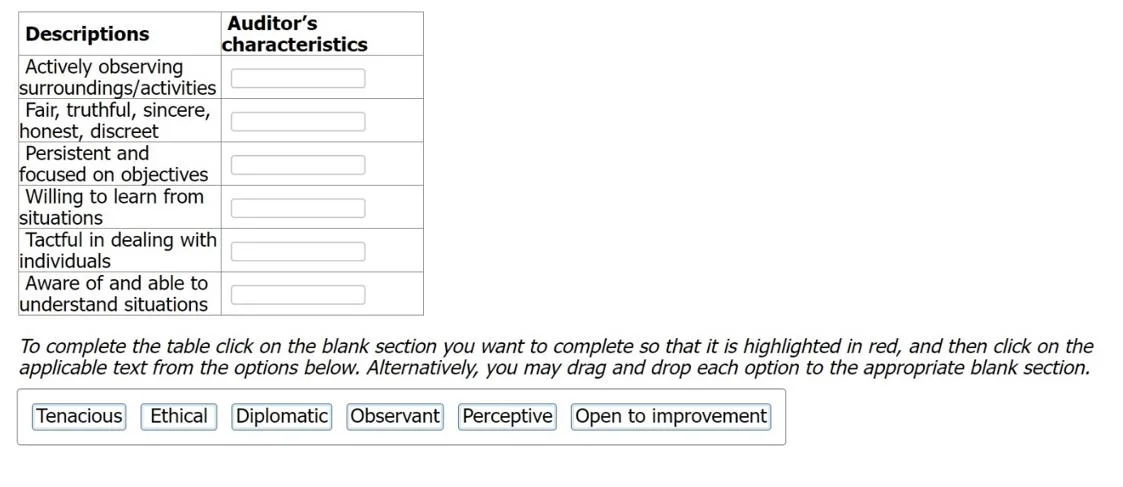
Answer Area
Drag items
Correct arrangement
- Observant
- Ethical
- Open to improvement
- Diplomatic
- Perceptive
Explanation
Auditor Personal Characteristics - Drag & Drop Explained
This question is based on ISO 19011:2018 (Guidelines for Auditing Management Systems), Section 7.2.2, which defines personal attributes auditors must possess.
The Correct Arrangement and Why
The descriptions in the question align with ISO 19011 definitions. Here is each placement:
| Position | Characteristic | ISO 19011 Description (inferred) |
|---|---|---|
| 1 | Observant | Actively aware of physical surroundings and activities |
| 2 | Ethical | Fair, truthful, sincere, honest, and discreet |
| 3 | Open to improvement | Willing to learn from situations and strive for better audit outcomes |
| 4 | Diplomatic | Tactful in dealing with people |
| 5 | Perceptive | Instinctively aware of and able to understand situations |
Individual Placement Reasoning
1. Observant - Points to physical awareness. An auditor must notice what's actually happening on the ground - processes, behaviors, conditions - not just what's documented. This is distinct from perceptive (which is intuitive/interpretive).
2. Ethical - Covers integrity: honesty, fairness, discretion. This is foundational; without it, audit findings lack credibility. Ethical behavior ensures auditees can trust the process.
3. Open to improvement - Means the auditor is willing to learn from each audit and refine their approach. This is forward-looking and self-reflective, unlike the interpersonal characteristics.
4. Diplomatic - Means tactful in dealing with people. Auditors must raise sensitive findings without damaging relationships or creating defensiveness. This is about delivery, not deception.
5. Perceptive - Means reading between the lines - sensing tension, recognizing when something is being withheld, or spotting inconsistencies intuitively. Higher-order than simply observing.
The Unused Item: Temperate
Temperate is the distractor. It does not appear in ISO 19011's list of auditor personal attributes. The standard uses terms like tenacious, decisive, and self-reliant instead. Candidates often mistake "temperate" (self-restrained, moderate) as plausible because auditors should remain calm - but the standard doesn't use this word.
Common Misconceptions
- Observant vs. Perceptive: Candidates frequently swap these. Observant = what you see; Perceptive = what you sense/interpret. Observant is external, perceptive is inferential.
- Diplomatic vs. Ethical: Diplomatic is about how you communicate; Ethical is about who you are (your integrity). They are not interchangeable.
- Temperate as valid: It sounds reasonable but is not part of the ISO 19011 framework - it's a trap option.
Topics
Community Discussion
No community discussion yet for this question.