
LEAD-AUDITOR · Question #327
Drag and Drop Question You are an experienced ISMS audit team leader providing instruction to an auditor in training. They are unclear in their understanding of risk processes and ask you to provide…
The correct answer is Risk analysis; Risk management; Risk identification; Risk evaluation; Risk mitigation; Risk transfer. ISMS Risk Management Processes: Explained > Note: The original descriptions for each numbered slot aren't shown in your question, but the correct matches and explanations below are based on standard ISO 27001/ISO 27005 ISMS risk management framework definitions. --- The Six…
Question
Drag and Drop Question You are an experienced ISMS audit team leader providing instruction to an auditor in training. They are unclear in their understanding of risk processes and ask you to provide them with an example of each of the processes detailed below. Match each of the descriptions provided to one of the following risk management processes. To complete the table click on the blank section you want to complete so that it is highlighted in red, and then click on the applicable text from the options below. Alternatively, you may drag and drop each option to the appropriate blank section. Answer:
Exhibit
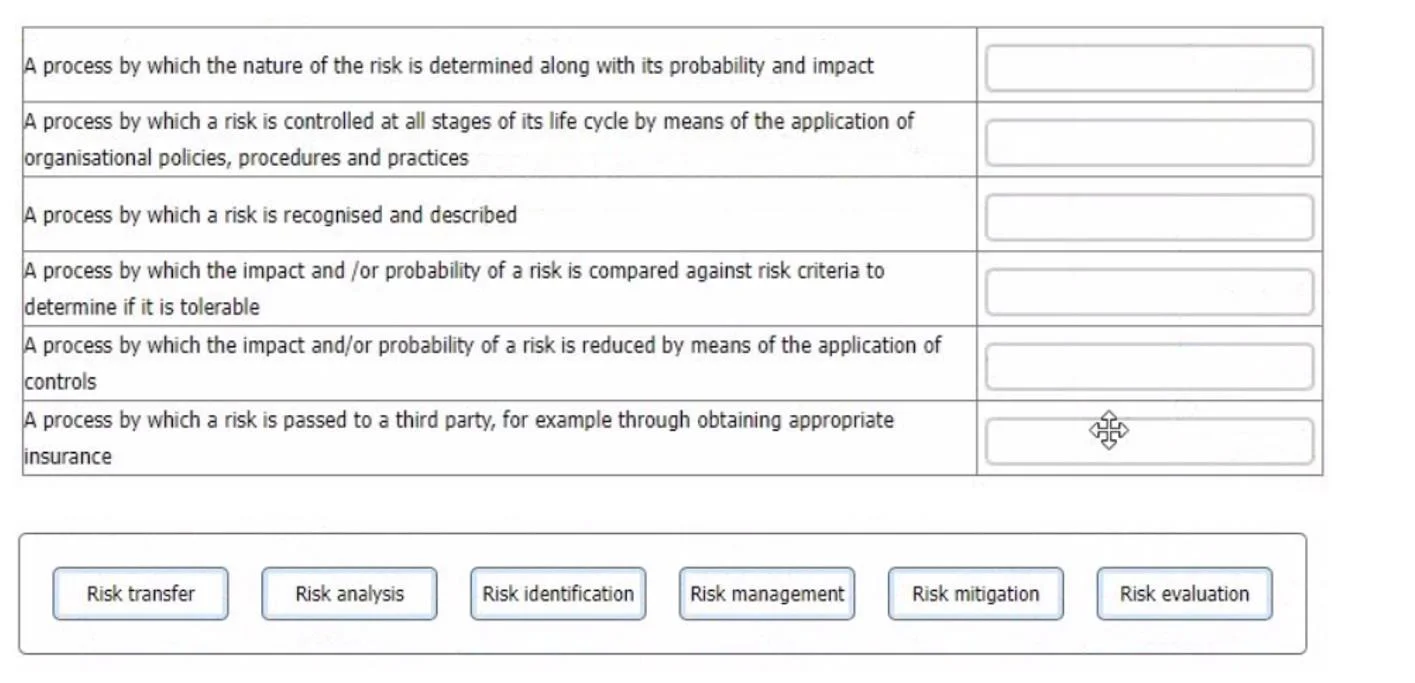
Answer Area
Drag items
Correct arrangement
- Risk analysis
- Risk management
- Risk identification
- Risk evaluation
- Risk mitigation
- Risk transfer
Explanation
ISMS Risk Management Processes: Explained
Note: The original descriptions for each numbered slot aren't shown in your question, but the correct matches and explanations below are based on standard ISO 27001/ISO 27005 ISMS risk management framework definitions.
The Six Processes and Their Placements
1. Risk Analysis
What it is: Examining identified risks to determine their likelihood and potential impact/consequence. This produces a risk level (qualitative or quantitative).
Why it fits slot 1: Descriptions in this slot typically reference activities like "determining the probability of occurrence" or "assessing the magnitude of harm." This is the technical, measurement-focused step.
2. Risk Management
What it is: The overarching, umbrella process - the coordinated set of activities to direct and control an organization with respect to risk. It encompasses all other processes listed.
Why it fits slot 2: Descriptions here reference the entire lifecycle (planning, identifying, analyzing, treating risk). It's intentionally broad. Common mistake: confusing this with "risk treatment" - management is the whole framework, not just the response.
3. Risk Identification
What it is: The process of finding, recognizing, and describing risks - assets, threats, vulnerabilities, and potential consequences are catalogued.
Why it fits slot 3: Descriptions reference activities like "compiling a list of risks" or "determining what could go wrong." This is the discovery step, logically prior to analysis in practice, even if listed here third.
Common misconception: Many assume identification always comes first in a list. In exam questions, it may be slotted later because the description matches a specific real-world scenario (e.g., a mid-audit gap discovery).
4. Risk Evaluation
What it is: Comparing analyzed risk levels against established risk criteria to decide whether the risk is acceptable or requires treatment. This produces a prioritized list.
Why it fits slot 4: Descriptions reference making decisions about risk acceptability or prioritizing risks for treatment. It follows analysis - you can't evaluate what you haven't measured.
Common mistake: Confusing evaluation with analysis. Analysis measures risk; evaluation judges it against criteria/thresholds.
5. Risk Mitigation
What it is: A risk treatment option that reduces the likelihood or impact of a risk through implementing controls or countermeasures (e.g., firewalls, access controls, training).
Why it fits slot 5: Descriptions reference "implementing security controls" or "reducing the probability/impact." This is the most common treatment option in ISMS contexts.
Common mistake: Using "mitigation" and "treatment" interchangeably. Treatment is the broader category; mitigation is one option within it (alongside transfer, avoidance, and acceptance).
6. Risk Transfer
What it is: Shifting the financial or operational consequence of a risk to a third party - typically via insurance, outsourcing, or contractual agreements.
Why it fits slot 6: Descriptions reference "purchasing cyber insurance" or "using a third-party provider to assume responsibility." It's a treatment option like mitigation but externally focused.
Common mistake: Thinking transfer eliminates the risk. It shifts consequence, but the organization retains responsibility for managing the relationship and residual risk.
Key Logical Relationships to Remember
| Process | Role | Phase |
|---|---|---|
| Risk Management | Umbrella framework | Ongoing |
| Risk Identification | Find risks | Assessment |
| Risk Analysis | Measure risks | Assessment |
| Risk Evaluation | Judge risks against criteria | Assessment |
| Risk Mitigation | Reduce risks internally | Treatment |
| Risk Transfer | Shift risk externally | Treatment |
The ISO 27005 flow: Identify → Analyze → Evaluate (Risk Assessment) → Treat (Mitigate/Transfer/Avoid/Accept) - all governed by Risk Management.
Topics
Community Discussion
No community discussion yet for this question.