
LEAD-AUDITOR · Question #322
Drag and Drop Question Select a word from the following options that best completes the sentence: To complete the sentence with the word(s) click on the blank section you want to complete so that it…
Explanation: ISO 19011 Audit Terminology Drag-and-Drop This question tests knowledge of ISO 19011 (Guidelines for Auditing Management Systems) - covering audit definitions, roles, responsibilities, and principles. The mappings fall into five logical groups. --- Group 1 - Audit…
Question
Drag and Drop Question Select a word from the following options that best completes the sentence:
To complete the sentence with the word(s) click on the blank section you want to complete so that it is highlighted in red, and then click on the application text from the options below. Alternatively, you may drag and drop the option to the appropriate blank section. Answer:
Exhibit
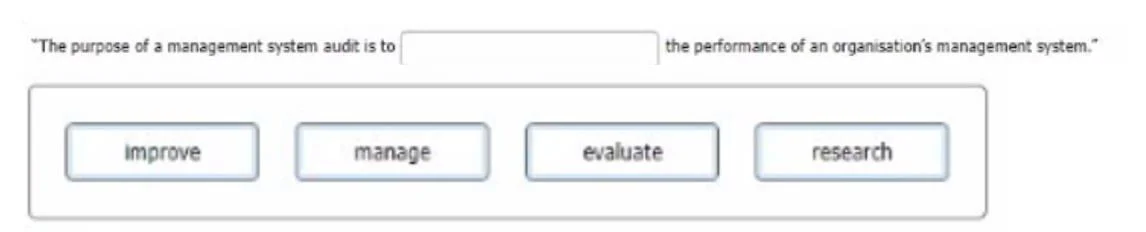
Options
- 1accuracy
- 2audit report
- 3clarity
- 4competence of the audit team
- 5decision made by the certification body
- 6reliability
- 7improve
- 8manage
- 9evaluate
- 10research
- 11Audit team leader
- 12Audit client
- 13Observer
- 14Auditee
- 15Technical expert
- 16Auditor
- 17select the audit team members
- 18act on behalf of the certification body
- 19compile checklists for the audit team
- 20identify non-conformances in the management system
- 21Audit conclusion
- 22Audit evidence
- 23Audit objective
- 24Audit criteria
- 25Audit scope
Explanation
Explanation: ISO 19011 Audit Terminology Drag-and-Drop
This question tests knowledge of ISO 19011 (Guidelines for Auditing Management Systems) - covering audit definitions, roles, responsibilities, and principles. The mappings fall into five logical groups.
Group 1 - Audit Output & Confidence Factors (Items 1–6)
These terms describe qualities of audit outputs or factors affecting confidence in audit results:
| # | Term | Why it goes here |
|---|---|---|
| 1 | accuracy | Audit evidence must be accurate - free from error and faithfully representing the facts observed. |
| 2 | audit report | The primary output of an audit process; it documents findings, conclusions, and evidence. |
| 3 | clarity | Audit reports must be clear so stakeholders can act on them without ambiguity. |
| 4 | competence of the audit team | ISO 19011 explicitly lists this as a key factor affecting confidence in audit conclusions. |
| 5 | decision made by the certification body | The certification decision is separate from the audit itself - the audit informs it but doesn't make it. |
| 6 | reliability | Paired with accuracy as a core requirement for audit evidence (ISO 19011 §6.5). |
Common mistake: Confusing the audit report (the auditor's output) with the certification decision (the body's output). Auditors report; certification bodies decide.
Group 2 - Purposes of Auditing (Items 7–10)
These verbs complete sentences about what management system audits are used to do:
| # | Term | Why it goes here |
|---|---|---|
| 7 | improve | Audits drive continual improvement - a core purpose per ISO 19011. |
| 8 | manage | Audits help organizations manage conformance and risk. |
| 9 | evaluate | The primary function of an audit is to evaluate conformity against criteria. |
| 10 | research | The least common audit purpose - sometimes used to gather baseline information. |
Common mistake: Thinking "evaluate" and "assess" are interchangeable in audit language - ISO 19011 uses "evaluate" specifically for comparing evidence against criteria.
Group 3 - Audit Roles (Items 11–16)
These are the defined roles within an audit program per ISO 19011 §3:
| # | Role | Defining characteristic |
|---|---|---|
| 11 | Audit team leader | Manages the audit team and process; accountable for the audit. |
| 12 | Audit client | The organization or person requesting the audit (may be external, e.g., a certification body). |
| 13 | Observer | Accompanies the audit team but does not act as an auditor; no evidence-gathering role. |
| 14 | Auditee | The organization being audited. |
| 15 | Technical expert | Provides specific knowledge/expertise but is not an auditor independently. |
| 16 | Auditor | Conducts the audit; collects and evaluates evidence. |
Common mistake: Confusing the audit client with the auditee. In third-party certification, the audit client is the certification body commissioning the audit; the auditee is the company being assessed.
Group 4 - Role Responsibilities (Items 17–20)
Each responsibility maps to the role best suited for it:
| # | Responsibility | Role it belongs to | Why |
|---|---|---|---|
| 17 | select the audit team members | Audit team leader | The team leader is responsible for planning and resourcing the audit, including team composition. |
| 18 | act on behalf of the certification body | Audit client | In third-party audits, the audit client (certification body) commissions and authorizes the audit. |
| 19 | compile checklists for the audit team | Technical expert / Audit team leader | Checklists are a preparation tool; the team leader coordinates this, often with technical expert input. |
| 20 | identify non-conformances in the management system | Auditor | Finding and recording non-conformances against criteria is the core auditor function. |
Common mistake: Assigning "select audit team members" to the audit client - the client may approve the team, but selection is the team leader's responsibility per ISO 19011 §5.5.4.
Group 5 - Core Audit Definitions (Items 21–25)
These are ISO 19011 §3 definitions, typically tested by matching to their descriptions:
| # | Term | ISO 19011 Definition (simplified) |
|---|---|---|
| 21 | Audit conclusion | The outcome of an audit after considering all findings against objectives. This is the final judgment. |
| 22 | Audit evidence | Records, statements, or other verifiable information relevant to the audit criteria. The raw material of an audit. |
| 23 | Audit objective | What the audit is intended to achieve (e.g., determine conformity, assess capability). |
| 24 | Audit criteria | The set of requirements (policies, procedures, standards) used as the reference to compare evidence against. |
| 25 | Audit scope | The extent and boundaries of the audit - which processes, locations, time periods are included. |
Logical order to remember: Scope → Criteria → Objective → Evidence → Conclusion (Define what you're covering → what you measure against → what you want to find out → what you collect → what you decide)
Common mistakes:
- Confusing audit criteria (the standard/requirement) with audit evidence (what you observe). Criteria = the measuring stick; evidence = what you measure.
- Confusing audit objective with audit scope. Objective = why you audit; scope = where/what you audit.
- Treating audit conclusion and audit findings as the same - findings are individual observations; the conclusion is the overall judgment derived from all findings.
Summary Table
| Group | Items | Topic |
|---|---|---|
| A | 1–6 | Audit quality factors & outputs |
| B | 7–10 | Purposes/uses of audits |
| C | 11–16 | Audit participant roles |
| D | 17–20 | Role-specific responsibilities |
| E | 21–25 | Core ISO 19011 definitions |
The key to this question is understanding ISO 19011's clear separation between roles (who participates), responsibilities (what each role does), definitions (precise terminology), and principles (why audits work).
Topics
Community Discussion
No community discussion yet for this question.