
JN0-692 · Question #22
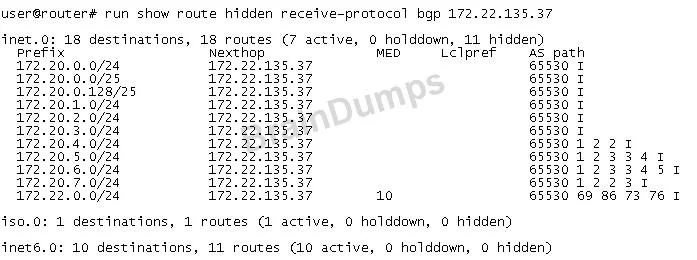
Click the Exhibit button. [edit] user@router# show protocols bgp group ebgp { import block-martian; family inet { unicast; } peer-as 65530; neighbor 172.22.135.37; } [edit] user@router# show…
The correct answer is C. The import policy is rejecting all routes from the EBGP peer. See the full explanation below for the reasoning.
Question
Click the Exhibit button. [edit] user@router# show protocols bgp group ebgp { import block-martian; family inet { unicast; } peer-as 65530; neighbor 172.22.135.37; } [edit] user@router# show policy-options policy-statement block-martian { term 1 { from { route-filter 0.0.0.0/8 orlonger reject; route-filter 127.0.0.0/8 orlonger reject; route-filter 191.255.0.0/16 orlonger reject; route-filter 192.0.0.0/24 orlonger reject; route-filter 223.255.255.0/24 orlonger reject; route-filter 240.0.0.0/4 orlonger reject; } } then reject; } [edit] You have established a peering with an EBGP neighbor, but the peer's 172.0.0.0/8 routes show as hidden. Referring to the exhibit, what is causing the problem?
Exhibit
Options
- AThe ebgp group configuration is missing an export policy needed to accept the routes.
- BThe route-filter used in the import policy is rejecting the 172.0.0.0/8 routes.
- CThe import policy is rejecting all routes from the EBGP peer.
- DThe ebgp group configuration for family inet unicast is causing a route mismatch.
How the community answered
(23 responses)- A4% (1)
- B4% (1)
- C83% (19)
- D9% (2)
Community Discussion
No community discussion yet for this question.