JN0-663 · Question #219
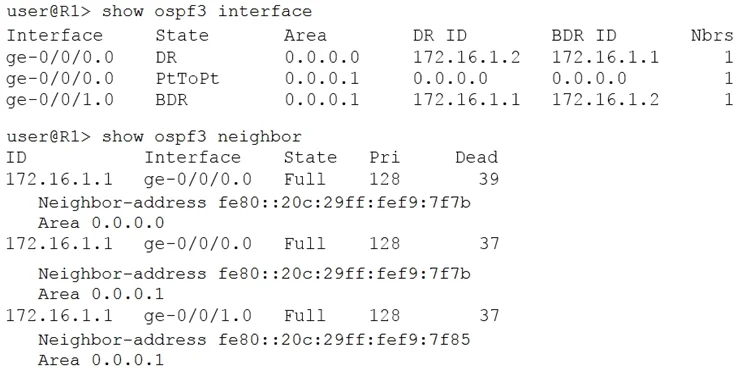
Referring to the exhibit, which OSPFv3 configuration is implemented on router R1?
The correct answer is C. set protocols ospf3 area 0.0.0.0 interface ge-0/0/0.0. By default, a single interface can belong to only one OSPF area. You can configure a single interface to belong in multiple OSPF areas. Doing so allows the corresponding link to be considered an intra-area link in multiple areas and to be preferred over other higher-cost intra…
Question
Referring to the exhibit, which OSPFv3 configuration is implemented on router R1?
Exhibit
Options
- Aset protocols ospf3 area 0.0.0.0 interface ge-0/0/0.0
- Bset protocols ospf3 area 0.0.0.0 interface ge-0/0/0.0
- Cset protocols ospf3 area 0.0.0.0 interface ge-0/0/0.0
- Dset protocols ospf3 area 0.0.0.0 interface ge-0/0/0.0
How the community answered
(18 responses)- A6% (1)
- B17% (3)
- C72% (13)
- D6% (1)
Explanation
By default, a single interface can belong to only one OSPF area. You can configure a single interface to belong in multiple OSPF areas. Doing so allows the corresponding link to be considered an intra-area link in multiple areas and to be preferred over other higher-cost intra- area paths. When configuring a secondary interface, consider the following: For OSPFv2, you cannot configure point-to-multipoint and nonbroadcast multiaccess (NBMA) network interfaces as a secondary interface because secondary interfaces are treated as a point- to-point unnumbered link. Secondary interfaces are supported for LAN interfaces (the primary interface can be a LAN interface, but any secondary interfaces are treated as point-to-point unnumbered links over the LAN). In this scenario, you must ensure that there are only two routing devices on the LAN or that there are only two routing devices on the LAN that have secondary interfaces configured for a specific OSPF area. ospf-areas.html#id-example-configuring-multiarea-adjacency-for-ospf
Topics
Community Discussion
No community discussion yet for this question.
