JN0-460 · Question #72
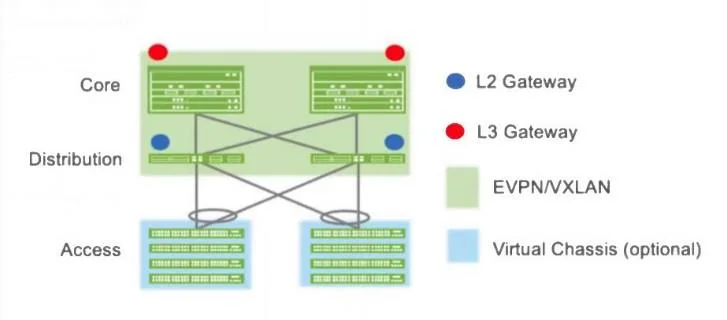
Click the Exhibit button. Which campus fabric architecture is shown in the exhibit?
The correct answer is D. core-distribution - centrally-routed bridging (CRB). The exhibit shows: L2 gateways (blue dots) positioned at the distribution layer. L3 gateways (red dots) positioned at the core layer. EVPN/VXLAN providing fabric connectivity between layers. Access switches forwarding traffic into the fabric without acting as gateways. This…
Question
Click the Exhibit button. Which campus fabric architecture is shown in the exhibit?
Exhibit
Options
- Acore-distribution - edge-routed bridging (ERB)
- B5-stage IP Clos
- C3-stage IP Clos
- Dcore-distribution - centrally-routed bridging (CRB)
How the community answered
(25 responses)- A16% (4)
- B8% (2)
- C4% (1)
- D72% (18)
Explanation
The exhibit shows: L2 gateways (blue dots) positioned at the distribution layer. L3 gateways (red dots) positioned at the core layer. EVPN/VXLAN providing fabric connectivity between layers. Access switches forwarding traffic into the fabric without acting as gateways. This directly maps to the centrally-routed bridging (CRB) model, where: Bridging occurs at the access/distribution layer. Routing (L3 gateway) occurs centrally at the core layer. "In the core-distribution CRB model, Layer 2 gateways are deployed at the distribution switches, and Layer 3 gateways are deployed centrally at the core switches." Option A (ERB) is incorrect because ERB places the L3 gateway at the edge/access. Option B (5-stage IP Clos) is incorrect -- that topology has a leaf/spine architecture, not core/distribution. Option C (3-stage IP Clos) is incorrect -- that eliminates the distribution layer. Option D (CRB) is correct, matching the diagram exactly.
Topics
Community Discussion
No community discussion yet for this question.
