nerdexam
Juniper

JN0-351 · Question #37

The ISP1.inet.0 route table has currently no routes in it. What will happen when you commit the configuration shown on the exhibit?

The correct answer is B. The inet.0 route table will be imported into the ISP1.inet.0 route table. The configuration shown in the exhibit is an example of a routing instance of type virtual-router. A routing instance is a collection of routing tables, interfaces, and routing protocol parameters that create a separate routing domain on a Juniper device. A virtual-router…

Protocol-Independent Routing

Question

The ISP1.inet.0 route table has currently no routes in it. What will happen when you commit the configuration shown on the exhibit?

Exhibit
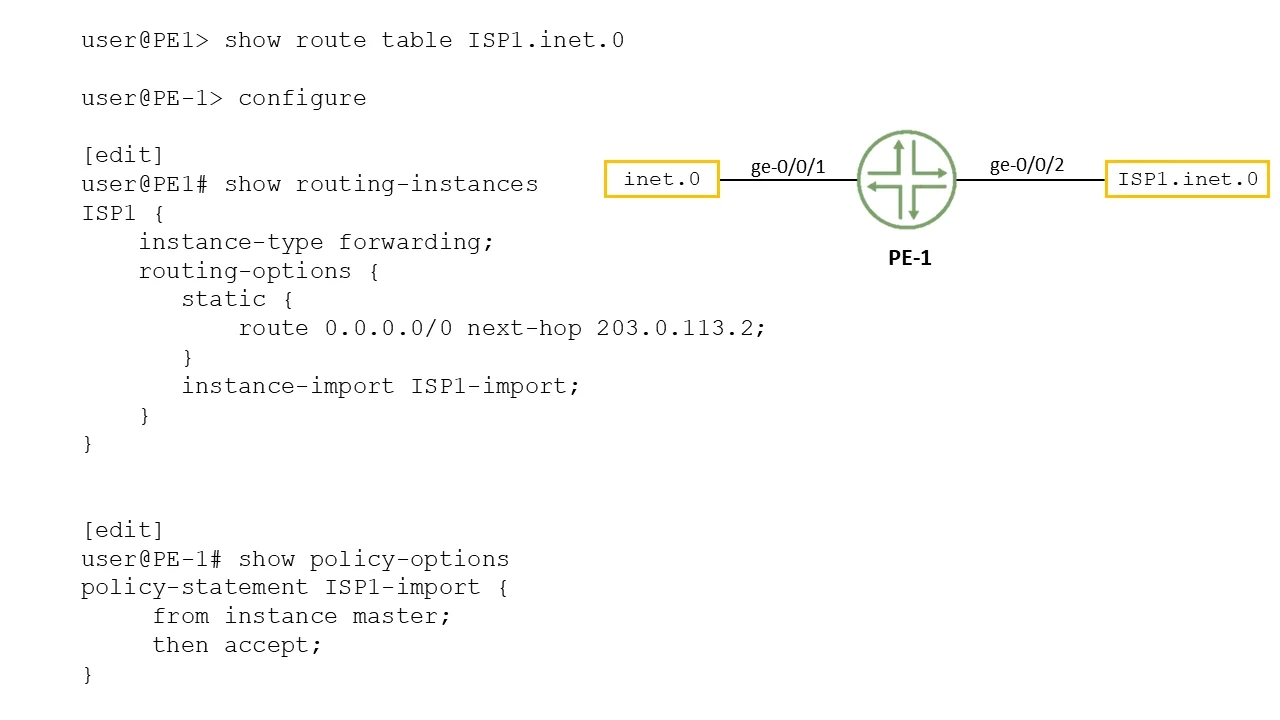
JN0-351 question #37 exhibit

Options

  • AThe inet.0 route table will be completely overwritten by the ISP1.inet.0 route table.
  • BThe inet.0 route table will be imported into the ISP1.inet.0 route table.
  • CThe ISP1.inet.0 route table will be completely overwritten by the inet.0 route table.
  • DThe ISP1.inet.0 route table will be imported into the inet.0 route table.

How the community answered

(34 responses)
  • A
    6% (2)
  • B
    74% (25)
  • C
    18% (6)
  • D
    3% (1)

Explanation

The configuration shown in the exhibit is an example of a routing instance of type virtual-router. A routing instance is a collection of routing tables, interfaces, and routing protocol parameters that create a separate routing domain on a Juniper device. A virtual-router routing instance allows administrators to divide a device into multiple independent virtual routers, each with its own The configuration also includes a rib-group statement, which is used to import routes from one routing table to another. A rib-group consists of an import-rib statement, which specifies the source routing table, and an export-rib statement, which specifies the destination routing table. In this case, the rib-group name is inet-to-ispi, and the import-rib statement specifies inet.0 as the source routing table. The export-rib statement specifies ispi.inet.0 as the destination routing table. This means that the routes from inet.0 will be imported into ispi.inet.0.

Topics

#RIB group#routing instance#route import#inet.0

Community Discussion

No community discussion yet for this question.

Full JN0-351 Practice