
JN0-346 · Question #36
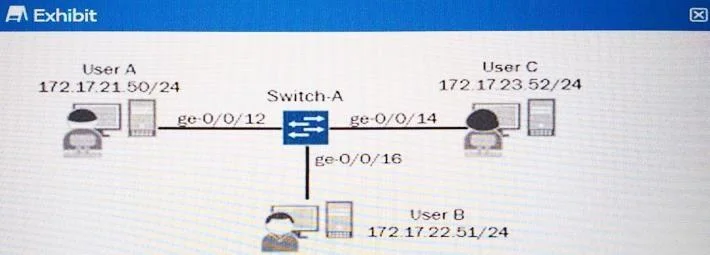
Click the Exhibit button. In the exhibit, each IP subnet in the network is associated with a unique VLAN ID. Which action will ensure that Host C will communicate with Host A and Host B?
The correct answer is B. Configure an IRB interface for each VLAN and associate it with its corresponding VLAN. Configuring Routing Between VLANs on One Switch To segment traffic on a LAN into separate broadcast domains, you create separate virtual LANs (VLANs). Of course, you also want to allow these employees to communicate with people and resources in other VLANs. To forward packets…
Question
Click the Exhibit button. In the exhibit, each IP subnet in the network is associated with a unique VLAN ID. Which action will ensure that Host C will communicate with Host A and Host B?
Exhibit
Options
- AConfigure all switch ports connecting to the host devices as access ports associated with a
- BConfigure an IRB interface for each VLAN and associate it with its corresponding VLAN.
- CConfigure all switch ports connecting to the host devices as trunk ports associated with all
- DConfigure a port-based ACL that permits inter-VLAN routing for all configured VLANs.
How the community answered
(38 responses)- A5% (2)
- B79% (30)
- C3% (1)
- D13% (5)
Explanation
Configuring Routing Between VLANs on One Switch To segment traffic on a LAN into separate broadcast domains, you create separate virtual LANs (VLANs). Of course, you also want to allow these employees to communicate with people and resources in other VLANs. To forward packets between VLANs you normally you need a router that connects the VLANs. However, you can accomplish this on a Juniper Networks switch without using a router by configuring an integrated routing and bridging (IRB) interface (also known as a routed VLAN interface-- or RVI-- in versions of Junos OS that do not support Enhanced Layer 2 Software).
Topics
Community Discussion
No community discussion yet for this question.